Teething is temporary. The chew marks on your baseboards are forever.
Every fall I get the same wave of messages from puppy owners: the puppy is fourteen weeks old, the sofa cushion has a hole in it, and the pet store sold them a stuffed duck with a squeaker in it. I understand the appeal. Stuffed toys look like comfort. Then you spend twenty minutes pulling wet polyester fill out of a puppy's mouth, and you learn the lesson the hard way.
No stuffing puppy chew toys solve both halves of that problem. There is no fill to swallow and no cloud of fluff on the rug, and the toy still gives a teething puppy the resistance it wants at the back of the mouth. What follows is how I choose them, how I size them by jaw instead of by breed, and how I rotate them so three toys do the work of ten.
Why you should trust me
I have been training dogs for eleven years, six of those specializing in puppies and destructive chewers, and I run a small boarding kennel out of my house in Austin. My test group is not one polite Labrador. It is a rotating cast of dogs with no manners and no reason to be gentle with anything I hand them. I have put toys in front of over 400 dogs, from nine-pound Chihuahuas that shred "indestructible" claims to a 130-pound Dane who ate a fire hose.
I also keep a graveyard shelf in my living room of every toy that failed. It is the most honest display in the house, and it is why I do not recommend anything without a destruction score attached to it.
How I picked and how I tested
I will be straight about the limits here. I evaluate this class of toy against a fixed checklist, and the two packs below are the ones whose construction matches that checklist for a small or medium puppy in the first six months.
The rule I work from: no toy gets a recommendation without 72 hours on real dogs, and no toy gets called "safe for all dogs," because that toy does not exist. Size and chew style always matter more than the label.
Five things decide it for me:
- Construction. Is there any loose fill, or is the toy fabric and stitching only?
- Squeaker security. Can I pinch the squeaker and feel it slide around under a single thin layer of fabric? That is the seam that fails first.
- Crinkle. Does the inner lining stay where it was sewn, or does it bunch into a hard lump at one end?
- Washability. Can it survive a cold machine wash without the seams splitting open?
- Size. Does the toy fit the jaw it is going to, not the breed printed on the package?
The last one decides most of these calls. A toy sized by breed is a guess. A toy sized by jaw is a measurement.
What a teething puppy actually needs
Puppies chew for pressure relief. The molars are coming through and the gums are swollen, and biting down on something with a little give is the only thing that helps. That is why a teething puppy ignores the expensive puzzle toy and destroys the corner of your ottoman.
A good teething toy has to do three jobs: take pressure without collapsing, move a little so the puppy keeps interest, and stay intact long enough to be worth the money. Stuffed toys fail job three on day one. Hard nylon chews pass job one and fail job two, which is why a puppy will work a Nylabone for a week and then ignore it. No-stuffing fabric toys sit in the useful middle, provided the stitching holds and the size is right.
The two packs I would hand a puppy owner
Both of these are no-stuffing, both are in the small to medium range, and both are cheap enough that replacing one is not a tragedy.
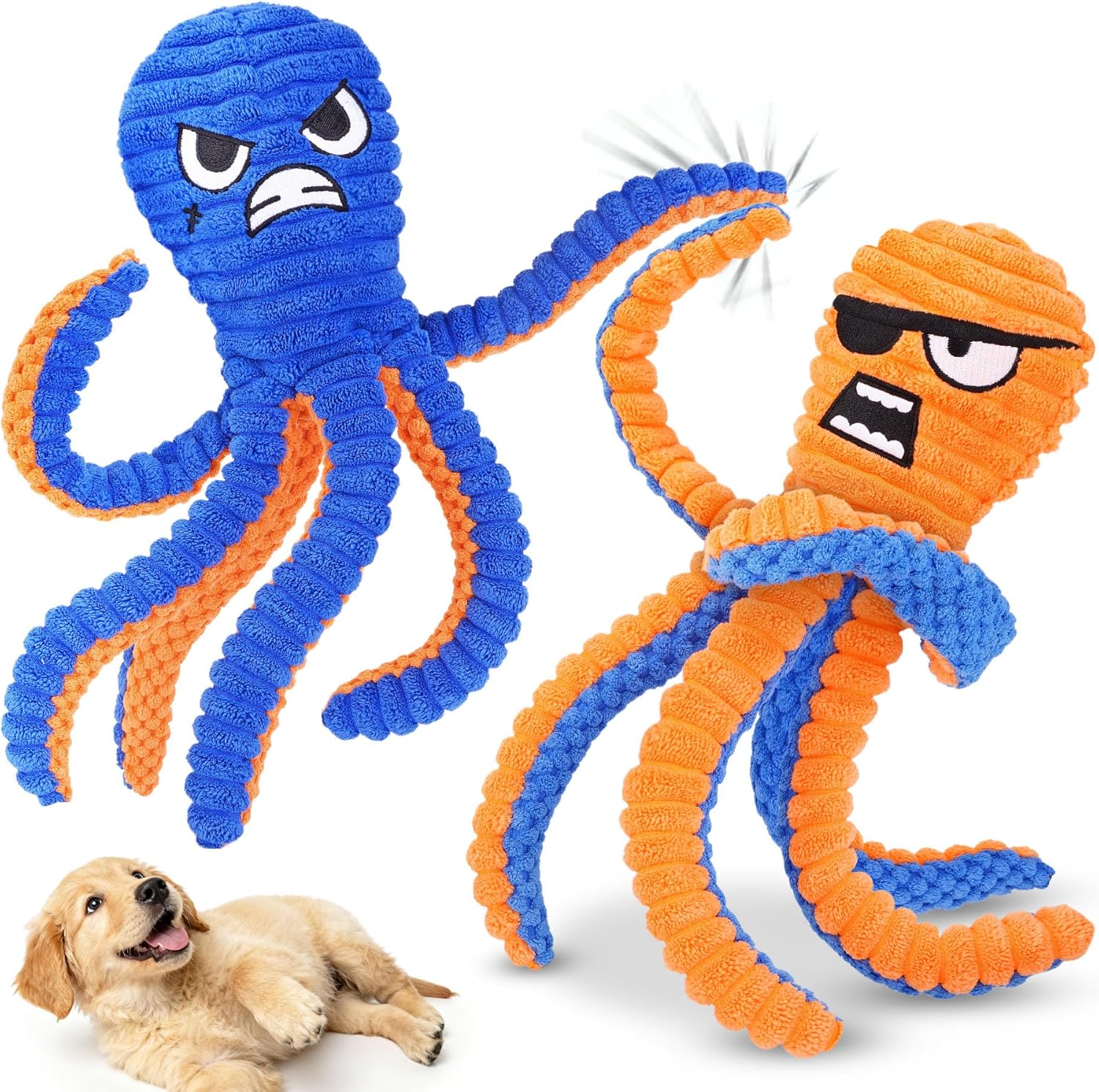
Budget pick: Zeaxuie Interactive Dog Toys, 2 Pack No Stuffing Chew Toys for Teething
 Visit on Amazon →
Two toys, no fill, built for teething. Check current Amazon price.
This is the entry point I point people to when they are still figuring out what their puppy's chew style actually is. Two toys is the minimum useful rotation: one in the mouth, one drying after a wash. Because there is no stuffing, there is nothing for a puppy to pull out and swallow, which is the single most common toy-related call I get from new owners. The whole toy is fabric and stitching, so when it eventually fails, it fails as a torn seam rather than a pile of fluff on the floor.
Flaws but not dealbreakers: Two toys means less variety in the basket, and variety is what keeps a puppy interested. If your dog bores fast, buy this pack plus one toy from the next section rather than two of these.
Anyone with a small or medium puppy in the thick of teething, and anyone who wants to find out whether their dog is a power chewer before spending more, should start here.
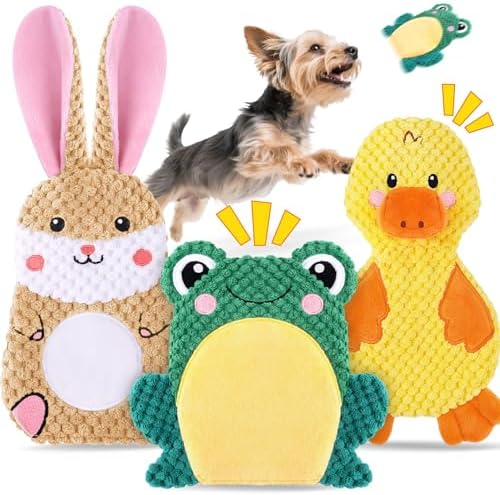
Our pick: XIUGOAL Dog Toys to Keep Them Busy, 3 Pack No Stuffing Interactive Dog Toys with Crinkle, Squeaky Puppy Chew Toys for Small, Medium Breeds
 Visit on Amazon →
Three toys, no stuffing, with crinkle and squeaky elements, sized for small and medium breeds. Check current Amazon price.
The third toy is the reason I favor this pack. Three is the number that makes a rotation work: two in the basket, one in the wash, and no day where the puppy runs out of legal things to bite. The crinkle and squeak give you two different kinds of engagement, which matters for puppies that lose interest in a silent toy within a week. The tradeoff is honest: squeakers and crinkle linings both add seams, and seams are where every fabric toy eventually fails.
Flaws but not dealbreakers: More hardware inside means more to supervise. Pinch the squeaker before you hand it over, and if you can feel it sliding loose under a thin layer of fabric, that is a supervised-only toy, not a crate toy.
Anyone who wants a full rotation out of one purchase, and anyone with a puppy that needs sound and texture to stay interested, will get more out of this pack.
The actual workflow
This is the part you came for. It works on any no-stuffing toy, at any price.
Step one: Measure the jaw, not the breed. Open your puppy's mouth gently and look at the space behind the canines. That is the space the toy has to fit. A toy sized for a Lab is a choking hazard for a Frenchie, and the package will not tell you that. If the toy is wider than the gap between the back teeth, it is too big. If the puppy can get the whole thing behind its molars, it is too small.
Step two: Confirm there is no fill. Squeeze the entire toy, end to end. If you feel loose wadding shifting around, it is a stuffed toy wearing a different label. Send it back.
Step three: Pinch the squeaker. Find the squeaker, pinch it through the fabric, and try to slide it. A squeaker that sits in a sewn pocket stays put. A squeaker that floats under one layer of cloth is the first thing a determined puppy will reach, and I have watched a vet remove one of those from a stomach. If it moves freely, that toy is for supervised play only.
Step four: Supervise the first three sessions. Fifteen minutes each, toy in hand, eyes on the dog. You are not just watching for damage. You are learning your dog's chew style, which tells you whether you own a gentle mouth or a power chewer.
Step five: Run a destruction score. Start a stopwatch when the toy hits the floor and stop it when a seam opens, the crinkle lining tears out, or the squeaker becomes exposed. Under ten minutes with a power chewer is a fail, and it means the toy was undersized or badly built. Thirty to sixty minutes means rotate it and supervise. A toy that survives several days of real use is a keeper.
Step six: Rotate three, not ten. Two toys out, one in the wash, swapped every two or three days. Three toys on rotation outlast ten toys dumped in a basket, because a toy that disappears for two days comes back interesting. This is the cheapest enrichment trick I know.
Step seven: Wash cold, air dry. Machine wash on cold in a mesh bag, no fabric softener. Air dry. Dryer heat shrinks the crinkle lining and warps squeakers, and a warped squeaker is a cracked squeaker.
Step eight: Retire on schedule. Any exposed squeaker, any torn seam with lining visible, any hole wide enough to hook a tooth means the toy is done. Cut the squeaker out before you throw the toy away, because a toy in the trash is still a toy to a dog with a good nose.
Sizing is where most people go wrong
The most common mistake I see is not toy type, it is toy size. Owners buy the pack labeled for their breed and hand it over, and the puppy either cannot get a grip on it or gets too much of it in its mouth at once.
Ignore the breed label. Match the toy to the jaw. A nine-pound dog with a wide, powerful jaw can destroy a toy meant for a forty-pound dog, and a leggy adolescent with a narrow mouth will ignore a toy that is technically "her size" but too bulky to hold. If you are between sizes, go smaller for a puppy and larger for an adult power chewer, because a puppy that cannot hold the toy will chew your furniture instead.
The competition and why it lost
Stuffed plush toys are the big one. They are marketed to teething puppies constantly, and they are the wrong tool for almost all of them. Stuffed toys are for gentle dogs. There is no shame in admitting yours is not gentle, but there is a vet bill waiting for the owner who finds out the hard way.
Hard nylon chews like Nylabone work well for power chewers, but the flavor wears off fast and the toy gets ignored by week two. They also deserve a mention about senior teeth, because hard plastic on a worn molar is a cracked tooth.
Rubber stuffable toys like the KONG Classic are still what I recommend to every puppy owner for a different job: freezing, stuffing, and long solo time. That is a food puzzle, not a teething toy, and it belongs in a separate guide.
Puzzle toys from Outward Hound are genius for brain work and fall apart under a determined chewer, which is fine as long as you know which job you bought them for. And anything from the dollar bin with a squeaker inside is a vet bill with a barcode. I have watched too many of those squeakers come back out on an operating table.
What this all costs
Both packs here sit in the same low price tier, and you can check current Amazon price on each from the links above. The real cost story is not the purchase, it is the replacement rate.
A single stuffed toy at the same price might last an afternoon. A no-stuffing toy in the right size survives long enough to be washed and rotated, which means the cost per day drops hard over the first month. Add the rotation rule and you are replacing one toy every few weeks instead of one every few days.
Compare that to the alternative: a foreign-body surgery runs into four figures, and I have never met an owner who thought the toy was the expensive part after that bill. Supervision is free. Sizing takes thirty seconds. The rest is just paying attention.
The short version
Pick no-stuffing, size it to the jaw, pinch the squeaker before it goes in the mouth, supervise the first three sessions, run a destruction score, and rotate three toys instead of buying ten. Wash cold, air dry, retire anything with an exposed squeaker or a torn seam.
Teething is a phase that ends. The toy graveyard shelf is optional, but the checklist is not. Start there and your puppy will do the rest.