Every puppy teething toy in the pet aisle promises to soothe sore gums, and almost none of them tell you what happens on day three. I have watched a nine-pound Chihuahua mix shred a toy the package called tough, and I have watched a big dog swallow a squeaker whole. Puppy teething toys are not a category you shop by cuteness. They are a category you shop by jaw size, material, and how fast your dog destroys things.
That last part is the number I care about most: the destruction score. It is the minutes until a toy is compromised, meaning torn, punctured, or missing a piece. Under 10 minutes with a power chewer is a fail, no matter what the label says.
This guide is about how to choose and use puppy teething toys so you are not buying replacements every week. Two sets do most of the work in my kennel, and I will show you exactly where each one fits.
Why you should trust me
I have been a dog trainer for 11 years in Austin, Texas, and six of those years were spent specializing in puppies and destructive chewers. I have put toys in front of more than 400 dogs, from tiny Chihuahuas to a 130-pound Dane who once ate a fire hose. My boarding kennel runs out of my house, which means every toy I bring home gets abused around the clock by dogs with no manners and no patience.
I also keep a graveyard shelf of every toy that failed. It is the most honest display in my living room, and it is the reason I do not recommend a toy until it has survived 72 hours on real dogs. No exceptions, no matter how good the marketing is.
How I picked and how I tested
Right now I am working through 2026 teething toys: six brands, 40 puppies, 12 weeks, and a destruction score for each one. The marketing says soothing. My stopwatch says something else.
When a new toy lands on my table, I ask four questions:
- Can a power chewer compromise it in under an hour?
- Is the size right for the target dog's jaw, not the target dog's breed?
- Does it survive 72 hours of real use?
- Would I hand it to a client's puppy unsupervised?
The two sets below are multi-piece variety packs for small dogs and puppies, and they pass the first screen for a simple reason: they give you options. A puppy that ignores a rope may chew a rubber bone for an hour. Variety is how you find out what your dog actually wants before you spend real money on a single premium toy.
Both sets sit in the budget tier, so check the current Amazon price on each before you decide. The point of a variety pack is not that every piece is great. The point is that you can find the three pieces your puppy loves, rotate those, and let the rest wait in the bin.
Size and material matter more than the label
Here is the rule I repeat to every client: size by jaw, not by breed. A toy meant for a Labrador is a choking hazard for a French Bulldog, and a toy meant for a Yorkie disappears down a Lab's throat.
Three material rules I do not bend on:
- Plush and squeaky toys are for gentle mouths and supervised play. If your puppy can gut a stuffed animal in five minutes, plush is not a teething toy, it is a pile of stuffing waiting to happen.
- Rope toys are for tug and gentle chewing, but loose strands need to be trimmed. A swallowed strand is a vet bill.
- Rubber and hard chew pieces are for the dogs that actually chew. Watch the wear. Once a piece is punctured or cracked, it is done.
And one more that outranks all of them: no toy replaces supervision. Chewing helps with teething relief, but the safety comes from you.
The two sets I keep in the rotation
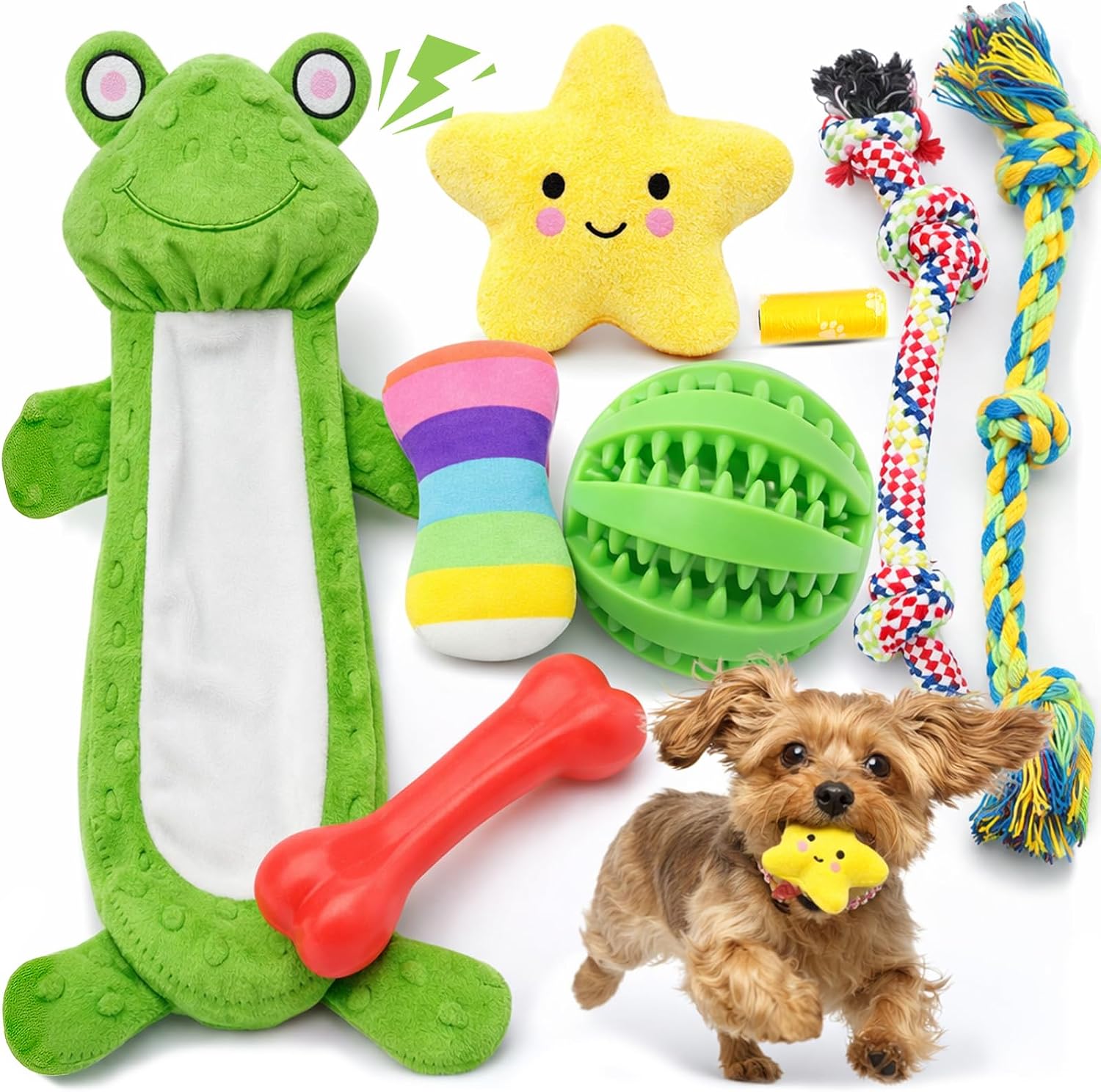
Best starter set for teething puppies: LOYEE 8 Pack Puppy Toys for Small Dogs, Luxury Dog Chew Toys with Squeaky Plush Toys, Rope Toys and Ball, Teething Toys for Puppy Supplies
 Visit on Amazon →
This is the set I hand to a client whose puppy is in the middle of the sharp-tooth window, usually somewhere between 12 and 20 weeks. Eight pieces, and the mix is the point: squeaky plush for the dogs that like soft things, rope for tug, a ball for fetch, and chew pieces for the dogs that need to sink their teeth into something. It is built for small dogs and puppies, so the scale is right for a mouth that is still figuring out how big it is.
What I like about a set like this is that it lets you find your puppy's chewing style in one purchase. Some puppies want texture. Some want motion. Some want to hear a squeak. You will know within a week which pieces get picked first, and those are the ones you rotate hardest.
The caveat is the same one that comes with any set containing plush and squeakers. Do not leave the plush pieces with a determined chewer. If your puppy starts pulling seams apart, that toy comes out of the rotation immediately. The rope and the rubber pieces are the ones that stay in the bin for unsupervised time.
For a first-time puppy owner who does not yet know what their dog likes, this is the cheapest way to find out. Check current Amazon price, and treat it as a sampler rather than a forever set.
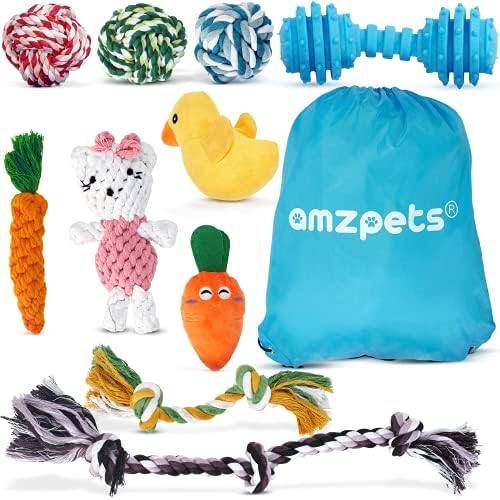
Best variety set for small dogs and puppies: AMZpets' 10-Piece Variety Dog Toy Set for Small Dogs & Puppies: Squeaky, Rope, Plush, Chew, Ball, Rubber Bone Toys & Carry Bag
 Visit on Amazon →
This one is for the household that wants more pieces and a place to keep them. Ten toys plus a carry bag: squeaky toys, rope, plush, chew pieces, a ball, and a rubber bone. The rubber bone is the piece I care about most, because it is the one with a real chance in front of a puppy who is already showing power chewer habits.
The carry bag sounds like a throw-in, and honestly it is, but it earns its place. Rotation only works if the toys you are not using are out of sight. A bag gives you somewhere to put the off-rotation pieces so they feel new again when they come back out.
The same caveats apply, and they are worth repeating. Plush is supervised play only. A squeaker comes out or the toy comes out of the rotation. Trim loose rope strands. The rubber bone is not indestructible, and nothing with a squeaker inside ever is, no matter what the package says.
This set is the better pick if you have more than one small dog, or if you want enough pieces to run a real rotation from day one. Check current Amazon price before you buy, and remember that ten cheap toys you rotate beat ten cheap toys dumped in a basket.
How to build a rotation that actually works
Rotation is the single biggest money saver in dog toys, and it costs nothing. Three toys on rotation outlast ten toys dumped in a basket, because novelty is what makes a toy interesting. Here is how I set it up for clients.
Step one: Sort by material, not by color. Make three piles: soft (plush, squeaky), tug (rope), and chew (rubber, hard pieces). You are building a rotation that covers different needs, not a matching set.
Step two: Pick one from each pile. That is your active set. Three toys, out where the puppy can reach them.
Step three: Bag the rest. Everything else goes in a bin or a bag, out of sight. This is the step people skip, and it is the step that makes rotation work.
Step four: Swap every three to five days. Pull the active three, put them away, bring out three different ones. Do not swap everything at once if your puppy has a clear favorite. Keep the favorite and rotate the other two.
Step five: Retire anything compromised. Torn seam, exposed squeaker, cracked rubber, frayed rope. It is done. Retiring a toy early is cheaper than a foreign body surgery.
Step six: Wash what survives. Most rope and rubber pieces handle warm water and a pet-safe soap. Skip the dishwasher for anything with a squeaker inside.
Step seven: Track what wins. After a month you will know whether your dog is a rope dog, a ball dog, or a chewer. That is the information you use for the next purchase, and it is worth more than any review.
How to run a 72-hour destruction test on a new toy
Every toy in my house goes through the same test before I recommend it, and you can run it at home.
Hour zero: Inspect it. Squeeze every seam. Tug the rope ends. Press the squeaker and feel where it sits inside the toy. If you can feel a hard plastic squeaker right under a thin layer of fabric, that toy is a supervision-only toy.
Hour one: Supervised play. Hand it over and watch. Note the first thing your dog attacks. Seams, ears, and squeakers go first in most dogs.
Hour two: The tug test. Tug gently. If the rope or the seam gives way with normal play, the toy will not survive a real chewer.
Hour 24: Check the damage. Look for punctures, exposed stuffing, and loose strands. Anything you can pull apart with two fingers is a fail.
Hour 72: Decide. If the toy still looks like a toy, it goes in the rotation. If it looks like a crime scene, it goes on the graveyard shelf and you learned something for the price of one toy.
That is the whole test. It takes almost no effort, and it tells you more than the label ever will.
Safety rules that matter more than any label
- Supervise plush and squeaky toys. Always.
- Size by jaw. If the toy fits entirely inside your dog's mouth, it is too small.
- No toy is safe for all dogs. Size and chew style always matter.
- Remove and replace compromised toys the same day.
- Stuffed toys are not teething toys for power chewers, no matter how they are marketed.
- If a toy smells like the factory that made it, wash it or send it back before it goes in your dog's mouth.
- Watch senior teeth with hard chew pieces. What a two-year-old power chewer handles easily can chip an older dog's tooth.
What this all costs
Both sets are budget-tier multi-packs, and I am not going to quote you a price that changes by the week. Check current Amazon price on each and do the math yourself.
The math I actually want you to run is the replacement math. A single premium chew toy that a power chewer destroys in a week costs more per month than a variety set that gives you three or four pieces your dog actually uses. Rotation is what turns a cheap set into a long-lived one. If you rotate three toys and swap every four days, a ten-piece set lasts well past the point where your puppy's adult teeth come in, which is the only deadline that matters here.
Compare that to the cost of one foreign body surgery, which is the real number in this conversation. It is the reason I pull squeakers, trim rope, and retire toys early.
The bottom line
Teething is temporary. The chew marks on your baseboards are forever, but temporary. Puppy teething toys are a tool, not a cure, and the tool works best when it matches your dog's jaw and chewing style instead of the picture on the package.
Start with a variety set so you can learn what your puppy likes. Rotate three toys at a time. Run the 72-hour test on anything new. Retire the failures without guilt, because a toy that fails the test is a toy that just saved you a vet bill.
The two sets above are the ones I keep on the shelf for small dogs and puppies. Pick the eight-piece if you want to find out what your puppy likes, and the ten-piece if you want enough to run a rotation from day one. Then do the boring part: supervise, swap, and watch the destruction score.