Most dog toys do not fail because the factory did a bad job. They fail because they got matched to the wrong jaw. A chew built for a Lab is a choking hazard for a Frenchie, and a plush duck sold as teething relief turns into fluff and a very expensive vet visit for a determined power chewer. Learning how to choose dog chew toys and puzzle toys comes down to three questions: how big is the dog's jaw, how does that dog chew, and who is watching while it happens.
I have been a trainer for 11 years, six of them focused on puppies and destructive chewers, and I run a small boarding kennel out of my house in Austin. That means the toys in my care get used around the clock by dogs with no manners and no interest in my opinions. I keep a shelf of every toy that failed. It is the most honest piece of furniture I own.
This is the process I use to decide what goes into a kennel run, what goes home with a client's new puppy, and what goes straight into the trash.
Why you should trust me
I have put toys in front of more than 400 dogs, from nine pound Chihuahuas that shred "indestructible" claims in an afternoon to a 130 pound Dane who ate a fire hose. I board dogs, which is a different job than selling toys. Nobody pays me a commission on what a dog plays with, and when a toy fails in my house, I am the one cleaning up the pieces and calling the owner.
My whole method rests on one number I call the destruction score: how many minutes a toy lasts before it is compromised. Under ten minutes with a power chewer is a fail, and the toy does not get a second chance. I have watched a client's puppy destroy a "tough" toy in under an hour while I explained, in detail, why the packaging was lying. That hour is why I write this way.
How I pick a toy before a dog ever touches it
Four checks, in this order. Skip one and you are guessing.
One, jaw size. Toy size matters more than toy type. A toy sized by breed on the label is marketing. Size it by the dog's actual mouth. If the chew is small enough to disappear behind the molars, it is a foreign body waiting to happen. If it is so large the dog cannot get a grip, the dog will ignore it and go find a baseboard.
Two, chew style. Watch your dog for five minutes with any toy. There are grazers, who nibble and lose interest, and there are power chewers, who work a single seam until it gives. A grazer can have a softer toy. A power chewer cannot, and no amount of wishing changes that.
Three, the 72 hour rule. No toy gets a recommendation from me until it has survived 72 hours of real use. Not a photo shoot, not a review copy, real dogs with real teeth in a real house.
Four, the failure plan. Before a toy goes home with anyone, I ask what happens when it fails. Does it shed small pieces? Does it have a squeaker that can be pulled out and swallowed? A toy that fails into a pile of stuffing is annoying. A toy that fails into a swallowable chunk is a vet bill.
You will notice I did not mention color, cuteness, or whether it matches your living room. Puppies do not care about aesthetics, and neither does your emergency clinic.
The two toys that earn their shelf space
I keep hundreds of toys in a basket and most of them are there because I could not stop testing. These two are the ones I actually hand to clients, and they do different jobs. One is for the mouth, one is for the brain.
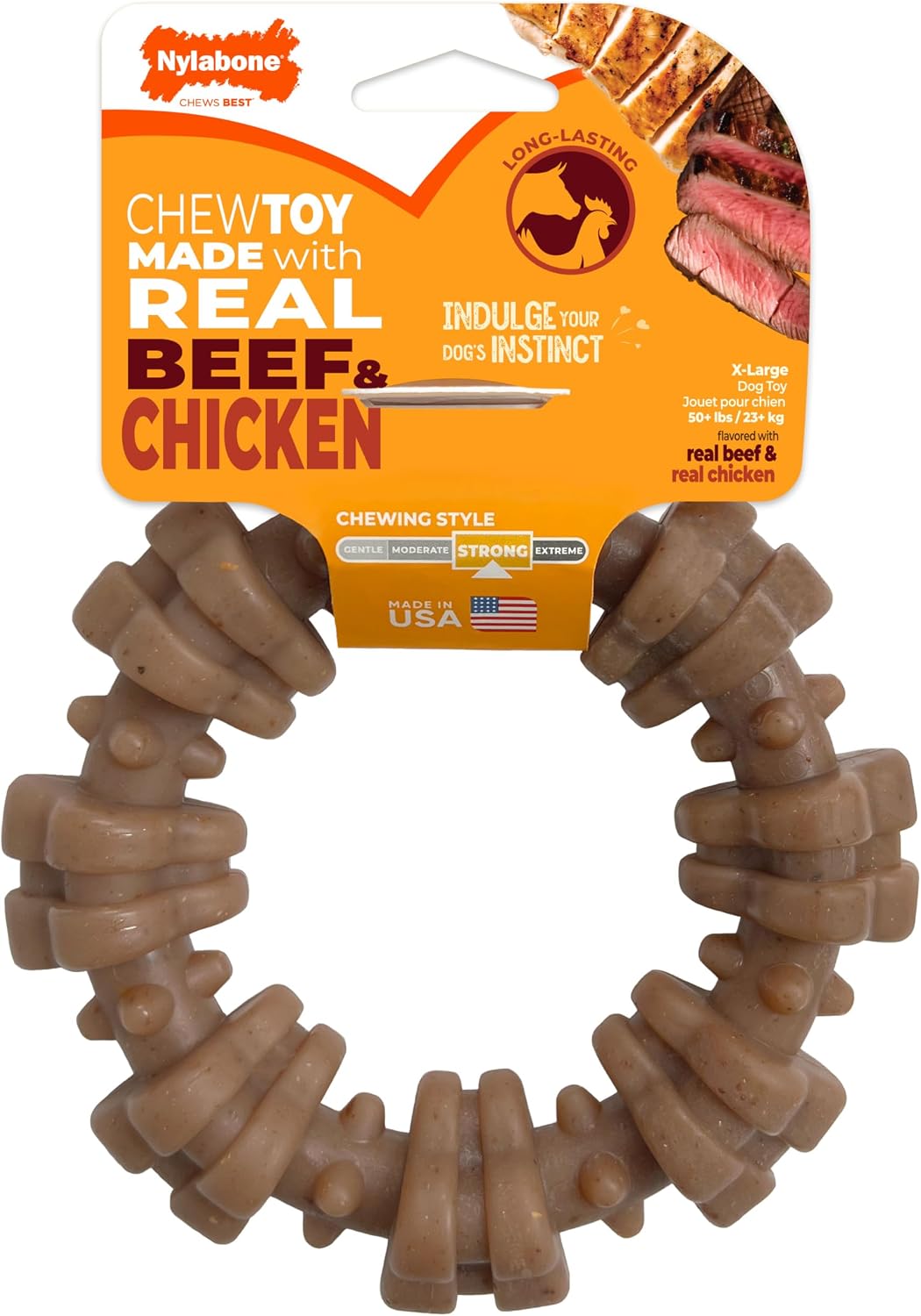
Best for power chewers: Nylabone Strong Chew Ring Dog Toy, Chew Toy Made with Real Beef & Chicken
 Visit on Amazon →
This is the chew I hand to the owner of a dog who has already eaten one couch cushion. The ring shape matters more than it looks: a ring gives a big dog something to hold with a paw while working the material, and it does not roll under the sofa the way a bone shape does. It is made with real beef and chicken, which is the only reason most dogs pick it up in the first place, and it is a firm chew rather than a soft one, so it satisfies the dogs who want resistance instead of a quick win.
The honest caveat is the flavor. Nylabone's scented material wears off faster than the toy does, and somewhere around week two a lot of dogs decide the ring is boring and walk away. That is normal. Do not panic and buy a replacement. Put it in the rotation basket for a few days and bring it back out, and most dogs re-engage with it. If yours never does, you have learned something useful about your dog's chew style.
Flaws but not dealbreakers: Firm material is not for every mouth. Senior dogs with worn teeth and any dog with a history of dental fractures should be evaluated by your vet before you hand over a hard chew. Size up, not down. If your dog is between sizes, buy the larger one.
Anyone with a confirmed power chewer between roughly 20 and 90 pounds will get the most out of this. If your dog is a grazer who abandons toys in four minutes, spend your money on the next pick instead.
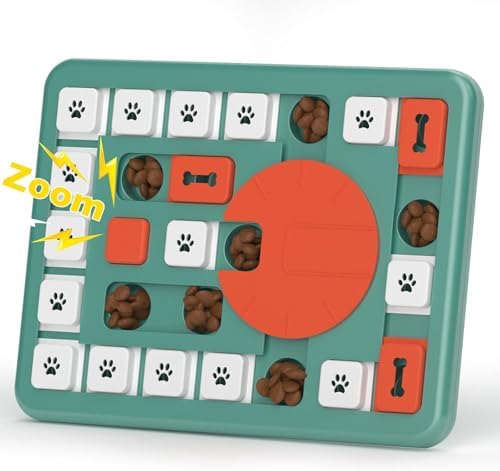
Best for brain work: PETSTA Dog Puzzle Toys, Treat Dispensing Dog Enrichment Toys for IQ Training and Brain Stimulation, Interactive Mentally Stimulating Toys as Gifts for Puppies, Cats, Dogs
 Visit on Amazon →
A tired brain chews less furniture. That is not a slogan, it is the single most useful thing I know after a decade of puppy calls. This puzzle is a treat dispensing toy, which means the dog has to work the mechanism to get food out, and the work is the point. Ten minutes of problem solving does more for a bored dog than an hour of fetch, because fetch is physical and this is mental, and mental fatigue is what actually settles a dog down.
The size range is genuinely wide. It works for puppies learning their first nose work, it works for adult dogs who need a job, and the listing even covers cats, which tells you it is a small treat puzzle rather than a large dog challenge. For a 90 pound dog, this is a warm up, not a main event.
Flaws but not dealbreakers: It is plastic with moving parts, and moving parts fail. A determined chewer will eventually crack a puzzle like this if you leave it down unattended. Use it as a supervised activity, pick it up when the treats are gone, and it will last a long time. Leave it in a crate with a dog who solves problems with teeth and you will be picking plastic out of the rug.
Anyone with a puppy, a senior who needs gentle enrichment, or an adolescent dog bouncing off the walls will get real value here. Pair it with a chew and you have covered both halves of the enrichment equation.
How to build a rotation that makes two toys feel like six
This is the part people skip, and it is the part that saves money.
Step one, pick three toys, not ten. Three toys on rotation outlast ten toys dumped in a basket. Dogs habituate to what is always available. Novelty is the active ingredient, and you can manufacture novelty for free.
Step two, split them by job. One chew, one puzzle, one comfort toy if your dog is gentle with plush. My kennel rotation is always one mouth toy and one brain toy, minimum.
Step three, rotate every three to four days. Two toys go in the basket, one comes out. That is the whole system. The toy that was boring on Tuesday is brand new on Friday.
Step four, retire on failure, not on boredom. A toy comes out of rotation permanently when it is compromised: cracked, torn, shedding chunks, or missing a squeaker. Boredom is not a reason to replace anything.
Step five, wash the rotation. Puzzle toys collect saliva and treat residue, and a puzzle that smells like old kibble gets ignored. Warm water, mild soap, air dry.
Sizing and supervision rules that prevent a vet bill
Three rules I will not bend on with clients.
First, no toy is safe for all dogs. Size and chew style always matter, and anyone who tells you otherwise is selling something. Second, a new toy gets ten supervised minutes on the floor with you watching, not a whole evening in a crate. Third, and this is the one people argue with me about, stuffed toys are not for chewers. They are for gentle dogs, and there is no shame in admitting yours is not gentle.
If your dog destroys a toy in under ten minutes, that is not a training problem. That is information. Size up and go firmer.
What I leave on the shelf
Anything from the dollar bin with a squeaker inside. I have watched too many of those squeakers come back out of a dog on an operating table, and I can tell you what the surgery costs. It is not worth the savings.
Stuffed toys marketed to teething puppies. A teething puppy needs something to sink teeth into that will not come apart into swallowable pieces. Plush is the opposite of that.
Toys sized by breed instead of by jaw. "For medium breeds" is a guess made by a copywriter. Your dog's mouth is not a category.
Toys that smell like the factory that made them. If it reeks of plastic and chemicals when you open the bag, your dog with the better nose is going to agree with you.
What this all costs
Two toys, rotated properly, will outlast a basket of six cheap ones that get shredded in a month. That is the whole math, and it is not close. Check current Amazon price on both picks and compare that against one emergency visit for a swallowed squeaker.
The expensive version of dog ownership is replacing broken toys on a schedule set by your dog's teeth. The cheap version is buying fewer, better toys and managing them.
Start with a chew and a puzzle. Rotate them. Watch your dog for the first ten minutes of anything new. Do that and you will spend less, replace less, and stop finding fluff in the hallway.
That is the job. Your dog was built to chew. Give it something worth chewing on.