Dog chew toys for aggressive chewers are the one category where the label matters least. I run a small boarding kennel out of my house in Austin, and I have a shelf in the living room that is essentially a graveyard: every toy that failed on a real dog, kept as evidence. When a client tells me their dog "destroys everything," I do not argue with them. I hand them a stopwatch.
The reason most chews fail has almost nothing to do with how tough the plastic claims to be. It has to do with size, jaw strength, and chewing style. A dog that gnaws with the back molars like a person working a corn cob will wear through a toy in a completely different spot than a dog that pins the toy with both paws and works one corner until it gives.
This is the protocol I use before any chew earns a place in the rotation, plus the two nylon chews I would start most owners on and the rules for what to do when the test goes wrong.
Why you should trust me
I have been a trainer for 11 years, six of those specializing in puppies and destructive chewers. I have put toys in front of over 400 dogs, from 9-pound Chihuahuas that shred "indestructible" claims to a 130-pound Dane who ate a fire hose. Boarding means toys get abused around the clock by dogs with no manners, which is a far harsher test than a quiet living room with one polite Labrador.
I also keep a rule that costs me free product: no toy gets a recommendation without 72 hours on real dogs. Not a photo session, not a five-minute chew on a rug. Three days of supervised use, then a verdict. If a toy fails, I note how it failed, because "it broke" is useless information. "It split along the seam and dropped a two-inch chunk" tells you everything.
How I picked and how I tested
Four things decide whether a chew is worth your money.
Destruction score. The minutes until a toy is compromised. Compromised means a crack, a chunk missing, a sharp edge, or a section chewed thin enough to flex. Under 10 minutes with a power chewer is a fail. That is the number I care about, not the word on the package.
Jaw fit. The chew should be wide enough that your dog cannot get it behind the molars and crush it, and long enough that a paw can hold one end while the mouth works the other.
Material behavior on failure. Nylon tends to wear down into nubs and, eventually, sharp points. Rubber tends to tear. Rope frays into strands that can wrap around a tongue. I will take a toy that fails slowly and visibly over one that fails suddenly.
Supervision requirement. No chew I have ever tested is safe for an unsupervised power chewer in a crate. That is not a knock on any brand. It is how jaws work.
One boundary up front: I do not make "safe for all dogs" claims. Size and chew style always matter, and any trainer who tells you otherwise is selling something.
The two chews I would start with
Both of these are nylon-type chews, which is the right material for a dog who needs a long, quiet chewing session rather than a puzzle to solve. They do different jobs. The two-pack gives you rotation built into one purchase. The wishbone gives you a shape that is easy to hold and easy to hand a dog who is bored rather than hungry.
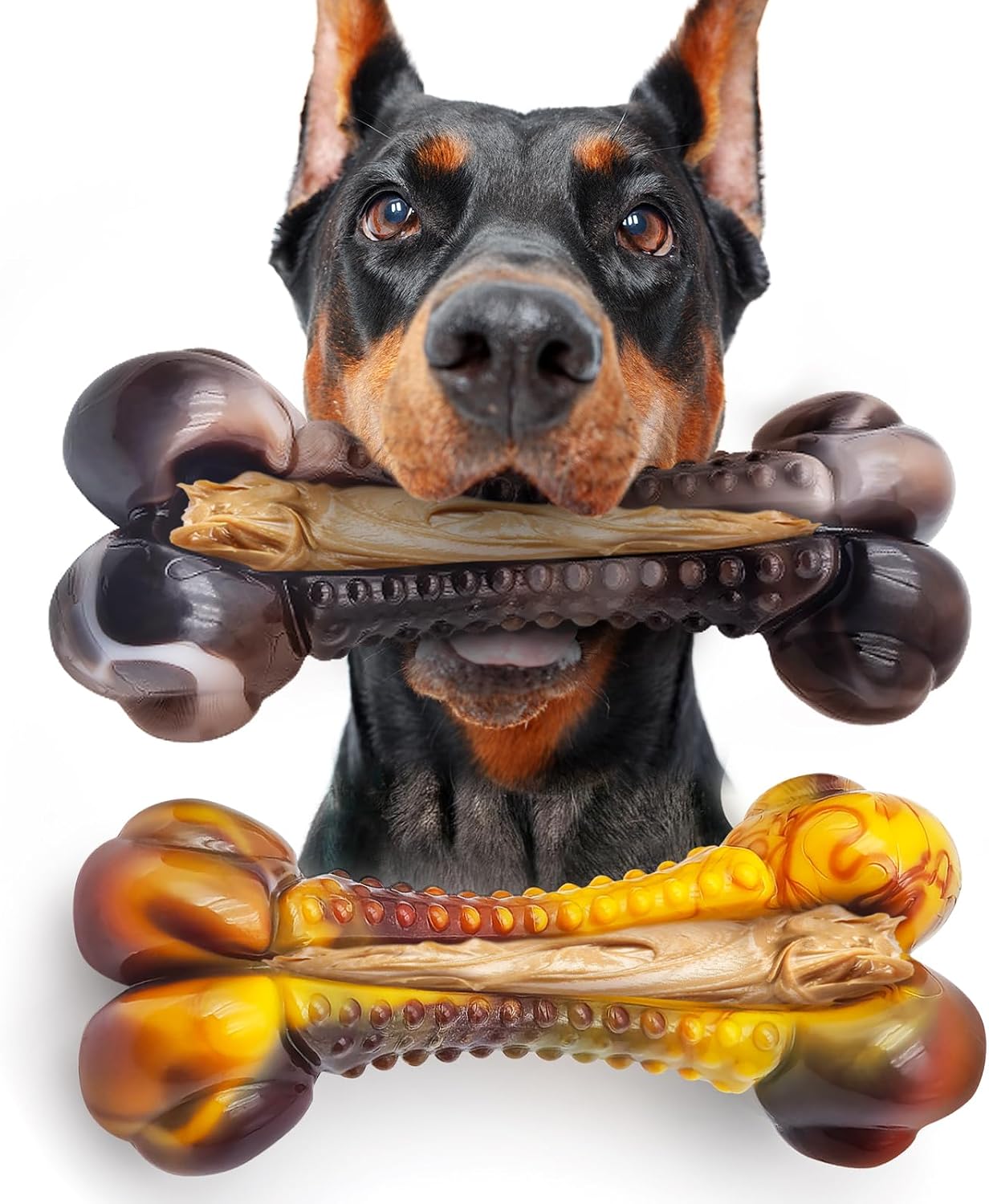
Budget pick: Dog Chew Toys for Aggressive Chewers, 2Pack Indestructible Dogs Bone Toy for Large Small Medium Breeds, Durable Tough Nylon Dog Toys To Keep Them Busy, Puppy Teething Dogs Toy Bone, Beef&Bacon Flavor
 Visit on Amazon →
The appeal here is the arithmetic of rotation: two bones in one box means you can keep one out and one put away, which is how you stretch a dog's interest across a week. The beef and bacon flavoring is an aroma coating, and like every flavored chew I have handled, it fades. When your dog loses interest in week two, that is normal. Wash it, let it dry, and put it back in the basket for a few days.
Read the breed list in that name as marketing, not as instructions. "Large Small Medium Breeds" means the manufacturer thinks one size fits everything, and my whole job is telling you it does not. If your dog's jaw is wider than your palm, this is not the toy for them. If you have a small or medium dog, or a puppy in the early teething stage, it is a reasonable first nylon chew at a low commitment.
Flaws but not dealbreakers: The ends are where these go first. Once the rounded tips are chewed into points, the toy has to go, because a point is how you get a gum injury. Check the ends with your thumbnail after every session.
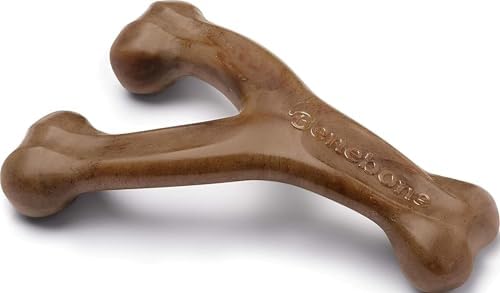
Our pick: Benebone Wishbone Dog Chew Toy for Aggressive Chewers, Real Bacon, Small
 Visit on Amazon →
Benebone is the best boredom chew I know of for a heavy chewer. The wishbone shape is the reason. A dog can plant a paw on one arm and work the other, which means the chew stays in one place instead of sliding across the floor while they chase it. For a dog that chews out of restlessness rather than hunger, that shape does more work than any flavor claim on the box.
Small is a size class, not a suggestion. It suits small jaws and puppies. It is not the toy for a Lab, a pit mix, or anything with a mouth that can swallow it whole. If you are buying for a big dog, buy the size up from this one, and if you are buying for a senior dog, read the next paragraph before you do.
Flaws but not dealbreakers: Nylon is hard, and hard is the point, but it is also the risk. Senior dogs with worn enamel, dogs with a history of slab fractures, and dogs who chew frantically rather than steadily should be cleared by your vet before they get any hard nylon chew. I have watched a dog chip a tooth on a chew that was perfectly appropriate for the dog next to it.
The 72-hour destruction test, step by step
Step one: size the chew to the jaw, not the breed. Hold the toy next to your dog's muzzle. It should be long enough to stick out on both sides of the mouth. If it disappears inside the mouth, it is a choking hazard, no matter what the package says.
Step two: first session, ten minutes, you in the room. Hand it over and do nothing else. Watch where the dog chews. Corner workers and molar grinders destroy toys in different places, and knowing your dog's pattern tells you where to inspect later.
Step three: start the stopwatch. Note the destruction score, the minutes until the first real compromise: a crack, a flex, a chunk. Under 10 minutes means the toy is not for this dog. Between 10 and 60 means it is a supervised-only chew with a short life. Over an hour with no compromise is a good sign.
Step four: inspect after every single session. Run a thumbnail along the edges. Nylon that has gone soft or fuzzy is on its way out. A sharp point or a deep crack means the toy is done, even if it looks mostly fine.
Step five: day two, add the second toy. Put both out and see which one your dog picks. That tells you more about your dog's preference than any product description. Whichever gets ignored goes into the closet for a week.
Step six: day three, test the boring version. Leave the toy on the floor while you cook dinner or answer email, with the dog in the same room. A chew that only holds attention when you are watching is not solving your problem.
Step seven: verdict. Pass means it goes into rotation. Rotate means it survives but only for short, supervised sessions. Retire means it goes on my graveyard shelf, and yours should go in the trash where the dog cannot reach it.
Sizing is where most owners get it wrong
Toys sized by breed instead of by jaw are my single biggest pet peeve in this category. A toy meant for a Lab is a choking hazard for a Frenchie, and a toy built for a Frenchie is a snack for a Lab. Breed tells you almost nothing. Jaw width, chewing style, and how your dog holds a toy tell you everything.
Two practical rules. First, the toy should be wider than the space behind your dog's last molar, so it cannot be rolled back and crushed. Second, when in doubt, size up for a power chewer and size down for a puppy, because a puppy's jaw is still soft and a too-large chew just gets abandoned.
Rotation beats buying more
Three toys on rotation outlast ten toys dumped in a basket. This is not a theory, it is the most consistent thing I see in my kennel. Novelty is the active ingredient. A chew that has been in the closet for a week comes out and behaves like a brand new toy, which means you spend less and your dog stays busier.
Pick three: one hard nylon for the long chew, one softer or food-stuffed toy for the busy brain, and one you can rotate in when the first two go stale. Swap weekly, not daily. And wash them, because a chew that smells like the factory that made it, or like three weeks of dog breath, gets ignored.
I will admit my own basket overflows, because I keep testing and I cannot stop. My dogs do not need it. Yours do not either.
Puppy teething: what changes
Teething is temporary. The chew marks on your baseboards are forever, but temporary. Puppies need a softer material than an adult power chewer, shorter sessions, and more of them. Chewing genuinely helps a puppy manage the pressure in the gums, but no toy replaces supervision.
Chill a chew in the freezer before handing it over for a sore-mouth day. Skip the stuffed toys marketed to teething puppies, since a puppy in full shred mode will find the seam before you finish reading the tag. If you see a little blood on the chew during heavy teething weeks, that is common, but check the gums and back off the hard chews until things settle.
What to do when a chew fails
Take it away immediately, bag it, and write down the destruction score. Then check your dog's mouth: lift the lips, look at the gums, run a finger along the outside of the molars. Watch for vomiting, drooling, pawing at the mouth, or lethargy over the next 24 to 48 hours. If any piece is unaccounted for, call your vet and say exactly that, because "a piece is missing" changes the conversation from wait-and-see to imaging.
This is the part nobody puts on the package, and it is the reason I note how a toy fails. A chew that wears down into nubs is annoying. A chew that breaks off a chunk is a vet bill.
The competition and why it lost
KONG Classic is still the only toy I recommend to every single puppy owner, and it is not on this list because it is a stuffable rubber toy, not a nylon chew. Freeze it, stuff it, done. It solves a different problem than a chew solves.
Nylabone is genuinely good for power chewers, but the flavors wear off fast and the toy gets ignored by week two. That is the same flaw the two-pack above has, and it is manageable with rotation.
West Paw Zogoflex is the best eco pick in the category, and the company actually recycles its own failed toys, which I respect. It is a softer material, so it is the wrong tool for a dog who wants to grind.
Outward Hound puzzle toys are genius for brain games and they fall apart if you leave them with a determined chewer. Puzzle toys are for supervised thinking, not unsupervised chewing.
And anything from the dollar bin with a squeaker inside is a vet bill waiting to happen. I have watched too many squeakers come back out of a stomach.
What this all costs over the year
The math is not close, and I am not going to pretend it is. Compare the cost of replacing a failed chew every couple of weeks against the cost of one foreign-body surgery and a night at the emergency clinic. One of those numbers you can absorb on a Tuesday. The other one you cannot.
What you are actually buying with a better chew is time. A toy that survives 72 hours is a toy that gives you a quiet hour in the evening, which is the entire point of the exercise. Buy two, run the test, keep three in rotation, and replace anything that develops a point or a crack the day you notice it.
That is the job. Your dog does not care what the package promised. They care whether the thing in their mouth holds up long enough to be worth chewing.