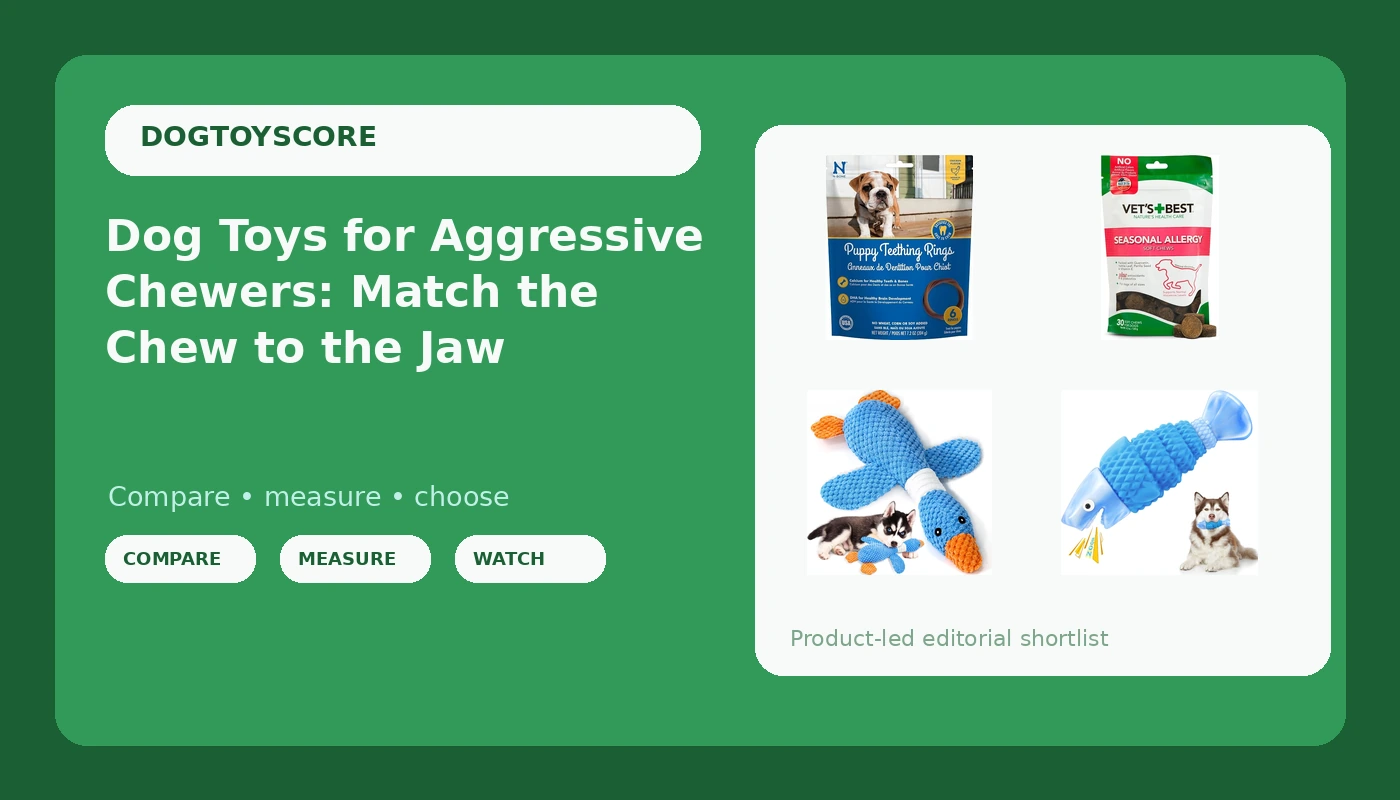
If you have ever searched for dog toys for aggressive chewers, you already know the problem: the results pile four different kinds of product into one list. A firm chew built for a dog that can flatten a tennis ball sits next to an edible ring designed for a nine-week-old puppy, and somewhere below that is a soft chew supplement that is not a toy at all. Buy the wrong one and you either waste money or hand your dog something that comes apart in pieces small enough to swallow. The fix is not hunting down the toughest toy ever manufactured. It is matching the product to the mouth that will be using it, and being honest about how your dog actually chews when nobody is watching.
Related: How to Rotate Dog Toys Without Buying More →
Quick answer
There is no single product that covers every dog. An edible teething ring is the right shape and texture for a puppy in the teething window, a firm durable chew is the right call for a power chewer who destroys plush and rope in minutes, and a soft chew supplement belongs in a completely different category because it is a food product, not a toy. Judge any chew on three things: the material it is made from, whether its size fits your dog's jaw rather than your dog's breed label, and what happens to it when it finally gives out.
4 useful options
| Model | Best fit | What stands out |
|---|---|---|
| Vitscan Upgraded Goose Indestructible Dog Toys for Aggressive Chewers | Power chewers who need a durable, non-edible chew | Goose-shaped durable chew built and marketed for aggressive chewers |
| N-Bone Puppy Teething Rings, Chicken Flavor, Calcium Enriched, 6 Rings | Puppies inside the teething window | Edible chicken-flavored rings, calcium enriched, sold in a six-count pack |
| WinTour Tough Dog Toys for Aggressive Chewers, Indestructible Dog Chew Toys | Heavy chewers who want a second durable option | Tough chew toy line positioned for aggressive chewers |
| Vet's Best Seasonal Allergy Soft Chews for Dogs, 30 Day Supply | Dogs with seasonal allergy concerns, under veterinary guidance | Soft chew supplement format with a 30 day supply |
The durable chew: Vitscan Upgraded Goose Indestructible Dog Toys for Aggressive Chewers
The word "indestructible" on the packaging is a marketing word, not a material specification. What matters is the actual material, the thickness of it, and how your dog attacks it. Some dogs work a chew with their back molars and grind it down slowly. Others pick at seams and edges with their front teeth, which is a completely different failure mode and often a faster one. A chew like this earns its place in a rotation if it holds its shape across several sessions, and it goes in the bin the moment a chunk comes loose.
The teething option: N-Bone Puppy Teething Rings, Chicken Flavor, Natural Puppy Teething Chews & Chew Treats, Helps Soothe Teething Gums, Calcium Enriched, 6 Rings
An edible ring is sized and textured for a puppy jaw, and that is exactly why it does not belong in the mouth of a fifty-pound adult chewer. A big dog can take an edible ring apart in a few bites, and swallowing large pieces of anything is how dogs end up in surgery. Give these to puppies, watch the whole session, and take away whatever is left when the ring gets small enough to swallow whole. Teething is temporary. The habit of supervised chewing is forever.
The second durable option: WinTour Tough Dog Toys for Aggressive Chewers, Indestructible Dog Chew Toys
Here is the part most buying guides skip: variety does more work than raw toughness. A dog that has one chew available will work on it until it is destroyed out of boredom. A dog that has two or three chews, rotated every few days, tends to treat each one as new again, and each one lasts longer as a result. If your dog has already chewed through the first option, having a second durable chew on the shelf means you are not buying a replacement under pressure, which is when people grab whatever is closest and cheapest.
The soft chew supplement: Vet's Best Seasonal Allergy Soft Chews for Dogs, 30 Day Supply
Itching, chewing at paws, and licking are the kinds of problems where the internet is a bad doctor. A supplement may be part of a plan your veterinarian puts together, and it may be entirely the wrong move if the cause is food, parasites, or a skin infection rather than seasonal allergens. Nothing here replaces a diagnosis. If your dog is on medication, has a sensitive stomach, or has known food sensitivities, run any new supplement past your vet before the first chew goes in the bowl.
Prices and availability may change. Product images, names, and retailer links are matched to verified listings. No current price, rating, stock status, or measured result is stated here without current evidence.
Why "indestructible" is a claim, not a material
Every durable chew on the market uses some version of the same language: tough, ultra tough, indestructible, built for power chewers. None of that tells you what the thing is made of, how thick the walls are, or whether it has a hollow core that collapses under molar pressure. The label is a promise made by a marketing department, and the dog does not read it.
What you can actually evaluate is simpler. First, the material: firm rubber-style chews behave differently from hard nylon-style chews, and both behave differently from an edible ring that is meant to be eaten. Second, the structure: a solid piece with no seams and no attached parts is safer than a piece with a squeaker, a rope, or a glued joint, because every one of those is a failure point. Third, the size relative to the jaw. A chew that is too small can be worked to the back of the mouth and swallowed. A chew that is too large gets abandoned.
This is where the destruction score comes in, and it is the only test I trust. Give the chew to the dog, set a timer, and watch. If the toy is compromised, meaning torn, punctured through, or shedding pieces, in under ten minutes with a serious chewer, it fails and it does not get a second chance. If it survives the session intact, it goes into the rotation and gets watched again tomorrow. A toy that survives three days of real use has earned its spot. A toy that survives one photo shoot has not.
How to match a chew to a jaw
- Score your dog's chew style first. Watch one session with a toy you already own and time how long it takes to show damage. Dogs that destroy in under ten minutes are power chewers and need the durable category only.
- Measure the jaw, not the breed. A chew should be large enough that your dog cannot get it behind the molars and small enough that the dog can actually hold it. Breed labels on packaging are a rough starting point at best.
- Pick the material by the job. Edible rings for puppies in the teething window, firm durable chews for power chewers, and soft chew supplements treated as food, dosed and stored like food.
- Ask what happens when it fails. A chew that breaks into large pieces is a nuisance. A chew that breaks into small pieces, or that releases a squeaker or a rope core, is a foreign body waiting to happen.
- Rotate and supervise. Three chews on rotation, swapped every few days, outlast ten chews dumped in a basket. And no chew, no matter what the package says, is a substitute for a person in the room.
Rotation, supervision, and what happens when a toy fails
- Rotate every two to four days. Novelty is the active ingredient. A chew that has been out of sight for three days gets treated like a new toy when it comes back.
- Supervise the first session completely. The first ten minutes tell you almost everything about how your dog will use the product.
- Retire damaged chews immediately. A chew with a torn edge, a puncture you can fit a finger into, or a loose piece is done, regardless of how much it cost.
- Size up when in doubt. If you are between two sizes, take the larger one. A chew that is slightly too big gets worked on. A chew that is slightly too small gets swallowed.
- Keep edible chews and supplements separate from toys. Edible products are consumed and counted as calories, and supplements are dosed on a schedule, not handed out as recreation.
Which option should you choose?
Choose the Vitscan Upgraded Goose Indestructible Dog Toys for Aggressive Chewers when you have a confirmed power chewer who destroys standard toys and you want a durable, reusable chew as the primary option. Choose the N-Bone Puppy Teething Rings, Chicken Flavor, Natural Puppy Teething Chews & Chew Treats, Helps Soothe Teething Gums, Calcium Enriched, 6 Rings when you have a puppy in the teething window and you want an edible chew sized for a small jaw. Choose the WinTour Tough Dog Toys for Aggressive Chewers, Indestructible Dog Chew Toys when you want a second durable chew so your dog is never working the same toy every single day. Choose the Vet's Best Seasonal Allergy Soft Chews for Dogs, 30 Day Supply when seasonal allergies are a concern your veterinarian has already weighed in on.
One caveat that applies to all four: none of these products is safe for every dog, and no listing can tell you how your individual dog will behave with it. Chew strength, jaw size, food sensitivities, and whether your dog gulps instead of chews all change the answer. The only reliable test is supervised use in your own home, with a plan for what you will do if the product fails.
The bottom line
Matching dog toys for aggressive chewers to the right dog is a matter of category and size, not brand loyalty. A durable chew for the power chewer, an edible ring for the puppy, a second durable option to keep the rotation moving, and a soft chew supplement that stays in the supplement lane. Read the material, check the size against your dog's jaw, watch the first session, and pull anything that starts to come apart. Do that and you will spend less on replacements than the person who keeps buying the toy with the loudest claim on the package.