Most people shopping for dog toys for aggressive chewers start with the word printed on the package: indestructible. That word is marketing, not a standard, and it is the reason so many owners end up at an emergency clinic with a dog who swallowed something they were told could not break. After eleven years of training dogs, six of them spent working with puppies and confirmed destroyers, I stopped trusting labels and started asking three questions instead. Can this toy be compromised into swallowable pieces? Is it sized to this dog's jaw? Would I hand it over and walk out of the room for the first session?
This guide walks through four currently available options that cover the jobs a chewer's toy box actually needs: a durable rubber chew, a second chew to rotate in, and something that tires the brain so the jaws get a break. It also explains what "indestructible" means on a listing, how to size a toy to a jaw instead of a breed, and when to retire a toy rather than hope it holds.
Related: How to Build a Dog Toy Rotation That Actually Lasts →
Quick answer
No dog toy is indestructible, and any listing that promises otherwise is describing an ambition rather than a guarantee. For a power chewer, the practical answer is a solid rubber or hard shaped chew that is too large to swallow, plus a second chew kept out of reach so you can rotate before boredom turns into destruction. A snuffle mat is not a chew toy, but it belongs in the same conversation because sniffing work tires a dog mentally and reduces the urge to gnaw on furniture. Buy for jaw size and chewing style, not for the breed label on the package.
Four useful options
| Model | Best fit | What stands out |
|---|---|---|
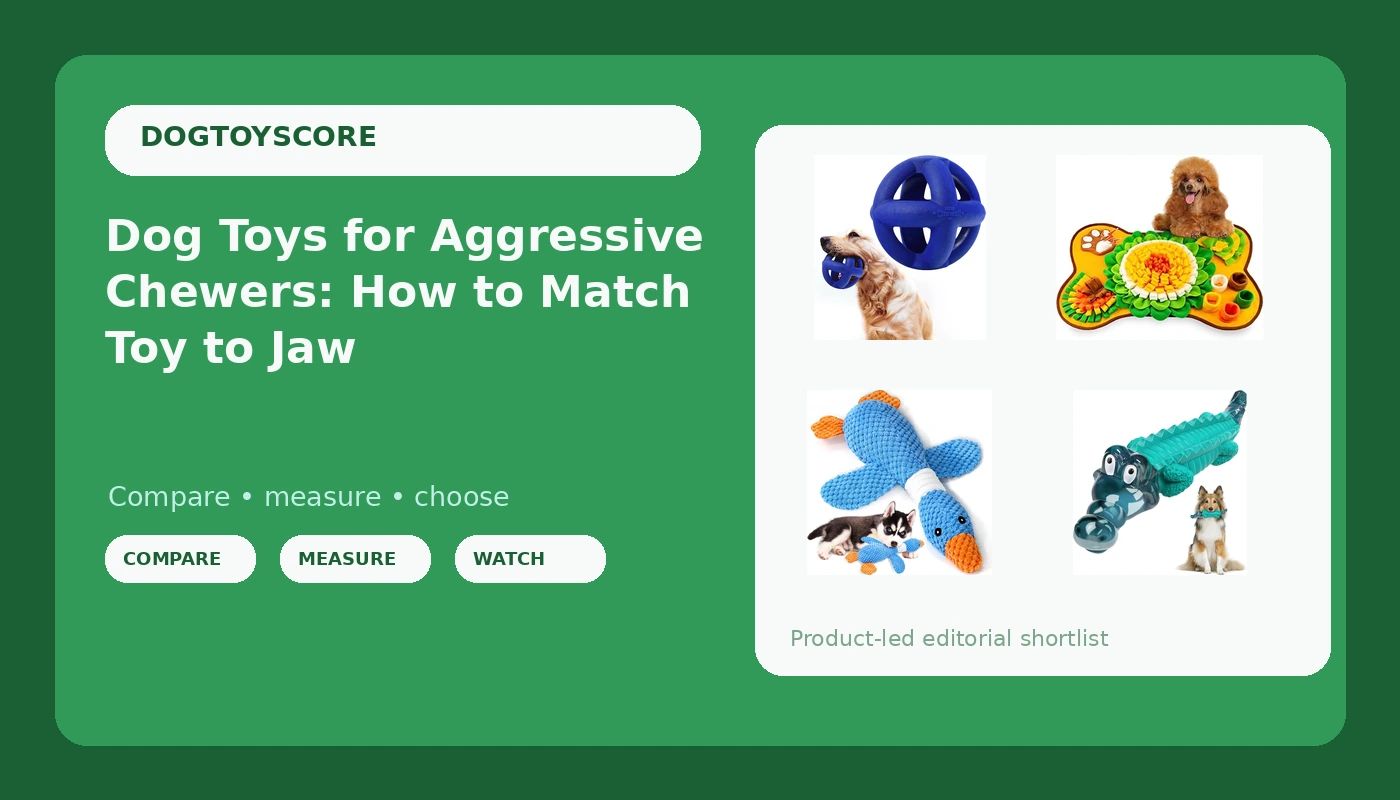
| SuperChewer Tough Dog Cage Ball Toy | Large breeds that fetch and chew | Strong natural rubber ball shape, and the listing states a lifetime replacement |
| Vitscan Upgraded Goose Indestructible Dog Toys for Aggressive Chewers | Dogs that work a shaped chew | Shaped rubber chew marketed specifically for aggressive chewers |
| Snuffle Mat for Dogs (Bone Shape, Orange) | Small and medium dogs that need mental work | Fabric sniff mat built for slow feeding, training, and stress relief |
| Jeefome Dog Toys for Aggressive Chewers | A rotation spare for a heavy chewer | A listing built around aggressive chewers |
The fetch-and-chew ball: SuperChewer Tough Dog Cage Ball Toy
A ball earns its place in a chewer's toy box because it does two jobs. It takes the jaw pressure, and it gives the dog a reason to move, which means a tired dog and fewer teeth marks on the baseboards. The trade-off with any rubber ball is that rubber flexes. A determined dog can work a seam or a chunk loose over time, so check the ball after every session and pull it the moment material goes missing.
Two other things are worth knowing before you buy. First, look at the listing details for anything small inside the toy, because the piece that causes most swallowed-toy surgeries is not the rubber, it is the squeaker or insert. Second, treat the "for large breeds" line as a size note, not a toughness certificate. A twenty pound dog can chew harder than a ninety pound dog. What the large breed positioning tells you is that this ball is big, and big is exactly what you want if the alternative is something that fits behind the molars.
The shaped rubber chew: Vitscan Upgraded Goose Indestructible Dog Toys for Aggressive Chewers
Shaped chews have a specific trade-off that a plain ball does not. Every edge, neck, and protrusion is a place where a patient dog can start a tear. A ball has one continuous surface. A goose has a head, a tail, and a body, and the thin spots are where the destruction score starts ticking down. That does not make it a bad toy. It makes it a toy you inspect more often, especially in the first week.
The shape does have real value, because dogs that get bored with a plain ball often keep working a shaped chew. Variety is what keeps a chew interesting past day two, and a chew that stays interesting is a chew that gets used instead of ignored. If your dog peels rather than crushes, watch the edges. If your dog crushes, watch the body for soft spots. Either way, retire it the day the first chunk separates.
The enrichment mat: Snuffle Mat for Dogs (Bone Shape, Orange)
Enrichment is the part of chew management most owners skip, and it is the part that changes behavior fastest. Sniffing is work. A dog that spends fifteen minutes rooting kibble out of fabric folds is a dog that settles afterward, and a settled dog does not redecorate your couch cushions. This is also the safest option in this group for a dog that is not a chewer at all, because there is nothing hard to break a tooth on.
The trade-off is that fabric is fabric. A dog who shreds plush toys will shred a snuffle mat, so this is a supervised activity, not a leave-it-in-the-crate item. Put it down, let the dog empty it, pick it up. Check the listing for care instructions before you wash it, and store it somewhere a bored dog cannot reach. If your dog is a confirmed fabric destroyer, this product is not for you, and that is fine.
The rotation spare: Jeefome Dog Toys for Aggressive Chewers
Rotation is the cheapest upgrade in dog ownership. Three toys cycled in and out of a cupboard outlast ten toys dumped in a basket, because novelty is what keeps a dog interested. When a toy comes back after a week away, it is new again. That is the entire trick, and it costs nothing.
The catch with any multi-piece listing is the smallest item in the set. A piece that fits behind the molars is not a chew toy for that dog, no matter what the package says. Lay everything out on the floor, compare each piece to your dog's open mouth, and set aside anything that could disappear. Then rotate what is left.
Prices and availability may change. Product images, names, and retailer links are matched to verified listings. No current price, rating, stock status, or measured result is stated here without current evidence.
What "indestructible" means on a dog toy listing
Indestructible is not a regulated term, and there is no industry standard behind it. It is a marketing word a seller chooses, and it means roughly what "premium" means on a bag of kibble. That does not make every toy with the label bad. It means the label itself tells you nothing, and you have to look at material, size, and shape instead.
What actually matters is the failure mode. Toys do not fail by vanishing. They fail by puncturing, peeling, or chunking, and each of those produces something a dog can swallow. A cracked ball, a chew with a missing corner, a rubber toy with a soft spot that flexes more than it used to: those are the moments that send dogs to surgery. So the honest durability question is not "will it break" but "when it breaks, will it break into pieces small enough to eat." A toy that fails into large, obvious chunks is safer than a toy that fails into gravel.
That is also why I do not call any toy safe for every dog. A toy is safe for a specific dog, at a specific size, under a specific level of supervision. Change any of those three and the answer changes with it.
Sizing a chew toy to a jaw, not a breed
Breed labels on packaging are the least useful sizing tool available, because breed tells you almost nothing about how a dog chews. Weight is better. Jaw width is better still. Here is the sequence I walk clients through.
- Open the dog's mouth and look at the width of the muzzle. The chew should be wider than the space behind the molars, so it cannot be swallowed whole even if the dog tries.
- Watch how the dog chews before you buy anything expensive. A peeler works edges and seams. A crusher applies pressure to the middle. The two need different shapes.
- Supervise the first sessions completely. You are not watching for fun, you are watching for the first sign of compromise.
- Rotate three toys instead of leaving one down all day. Novelty does more for durability than thickness does.
- Retire the toy the day it fails. Not the week it fails. The day.
Practical guidance for a chewer's toy box
- Buy for the dog you have, not the dog you hoped for. If yours destroys plush, stop buying plush.
- Ignore breed sizing on the package and use jaw width and chewing style instead.
- Keep anything with a squeaker out of an unsupervised chewer's reach, because the insert is the hazard.
- Add sniffing work with a snuffle mat or scattered kibble to reduce jaw work overall.
- Check the listing's size chart and material details, and check current Amazon price, before you commit to a toy your dog may outgrow.
Which option should you choose?
Choose the SuperChewer Tough Dog Cage Ball Toy when you have a large dog that fetches and chews and you want one rubber item that does both jobs. Choose the Vitscan Upgraded Goose Indestructible Dog Toys for Aggressive Chewers when your dog gets bored with a plain ball and keeps working a shaped chew. Choose the Snuffle Mat for Dogs (Bone Shape, Orange) when the problem is mental, not dental, and your small or medium dog needs a job that tires the brain. Choose the Jeefome Dog Toys for Aggressive Chewers when you want a second chew to rotate in so the primary toy is not down all day.
None of these picks replaces supervision, and none of them is a lifetime purchase for a serious power chewer. Durability depends on the dog in front of you, and the only honest way to judge it is to watch the first sessions closely and inspect the toy afterward.
The bottom line
Dog toys for aggressive chewers are a matching problem, not a shopping problem. Solid rubber in the right size, rotated often, supervised at first, and retired the moment it fails will outperform any toy that claims to be unbreakable. The four options here cover the useful roles: a rubber ball for fetch and chewing, a shaped chew for variety, a snuffle mat for the brain, and a spare chew for rotation. Pick the role you are missing, check the size against your dog's jaw, and keep the graveyard shelf going for the ones that do not make it.