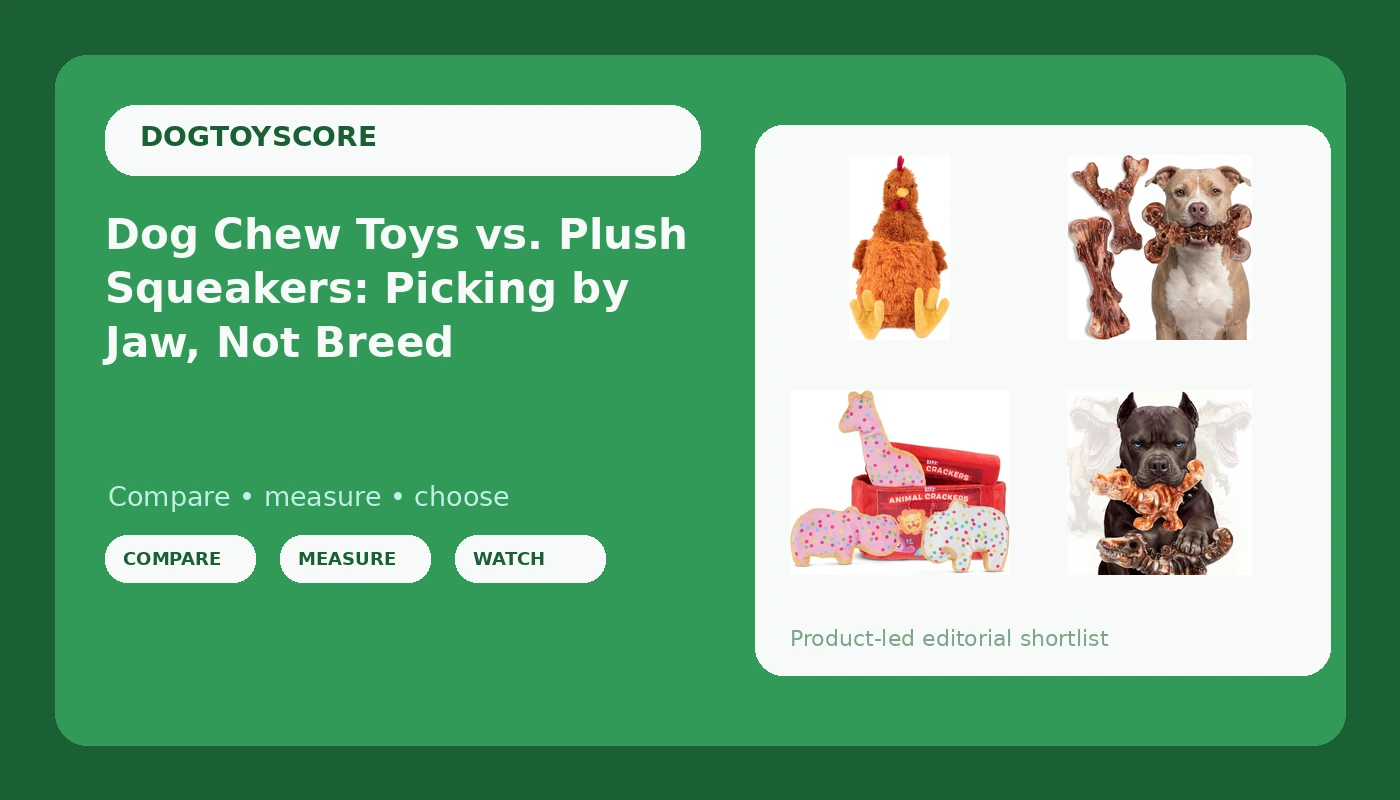
Most dog toy shopping goes wrong in the same place: the label. A box that says "indestructible" and a box that says "interactive plush" can look equally appealing on a shelf, but they are built for two completely different dogs. If you are shopping for dog chew toys for aggressive chewers, the plush aisle is not your aisle. If you have a nine-pound senior who carries a stuffie around like a baby, a rock-hard nylon bone is going to sit in the basket untouched while the same dog shreds a crinkle chicken in an afternoon.
The fix is not a better brand. It is sorting the options by the job they actually do: gentle play, supervised destruction, variety for a dog who gets bored, and long-haul chewing for the dog who treats every toy like a challenge. This guide walks through four currently available toys, what each one is for, and where each one fails.
Related: How to Rotate Dog Toys So They Stay Interesting →
Quick answer
Match the toy to the jaw and the play style, not to the breed printed on the package. A crinkle squeaker toy suits gentle players and supervised fetch. A multi-toy pack and a rock-hard nylon chew suit dogs who can compromise a standard toy quickly. An interactive plush set sits in the middle, best for dogs who like to shake and squeak rather than dissect. Rotate two or three toys instead of leaving everything in the basket, and supervise the first session with anything new.
Four useful options
| Model | Best fit | What stands out |
|---|---|---|
| Best Pet Supplies Interactive Squeaky Dog Toy - Crinkle Chicken, Brown | Gentle players and supervised fetch | A single crinkle-texture toy with a built-in squeaker |
| Kseroo 3-Pack Indestructible Dog Chew Toys for Aggressive Chewers,30-100lbs | Power chewers who burn through single toys | Three chew toys in one purchase, sized for larger dogs |
| BarkBox Animal Squeakers 4-in-1 Interactive Plush Dog Toy | Dogs who shake, toss, and squeak | A four-in-one plush set built around squeakers |
| DinoBone 2-Pack Tough Dog Chew Toys for Aggressive Chewers, Rock-Hard Nylon | Long, boring chewing sessions | Two rock-hard nylon chews in one pack |
Best for gentle players: Best Pet Supplies Interactive Squeaky Dog Toy - Crinkle Chicken, Brown
Here is the honest framing on any toy with a squeaker: the squeaker is the interesting part, which means it is also the part a determined dog works toward. Crinkle fabric and a squeaker are excellent for a dog who wants to chase, carry, and pounce. They are a countdown timer for a dog who wants to open things up.
So this one belongs in the hands of a gentle player, or in yours during supervised fetch and tug. If your dog is a carrier, the kind who parades a toy around the house and sleeps next to it, this style of toy can last far longer than you would expect. If your dog is a dissector, the kind who pins a toy with both front paws and goes to work on a seam, skip it. Not because the toy is badly made, but because it is made for a different mouth.
Size check: this is a small, soft toy. It should never be left with a dog who mouths and swallows fabric, and it should not be offered to a dog large enough to take the whole thing into the back of the mouth.
Best for a destruction-prone rotation: Kseroo 3-Pack Indestructible Dog Chew Toys for Aggressive Chewers,30-100lbs
The value here is not that any single toy is unbreakable. It is that you get three toys, which makes rotation practical instead of theoretical. Three toys that come out one at a time stay novel for weeks. Ten toys dumped in a basket become furniture within days, because a dog who can see all of them at once stops caring about any of them.
Treat "indestructible" as a dare, not a guarantee. Whatever the material, a serious chewer will eventually find the weak point, and that weak point is usually a seam, a joint, or a spot where the material thins out. Your job is to inspect each toy after every session and retire it the moment you see a crack, a chunk missing, or a piece that flexes where it used to be solid.
The weight range on the label is a starting point, not a rule. A 35-pound pit mix can out-chew a 90-pound retriever, and a toy sized for the top of that range may be awkward for a dog at the bottom of it. Buy for the jaw, then supervise.
Best for interactive plush play: BarkBox Animal Squeakers 4-in-1 Interactive Plush Dog Toy
This is the middle of the road option, and there is no shame in the middle of the road. Plush toys are not for chewers. They are for gentle dogs, for puppies in the mouthing stage who need something soft to carry, and for interactive games where you are part of the play. A set of four means you can keep two out and store two away, which stretches the novelty without buying anything else.
Two rules for plush in a house with any dog over 20 pounds. First, plush is a supervised toy, not a crate toy. Second, when a seam opens, the toy is done. A squeaker that comes loose is a foreign body risk, and the cost of that surgery is not a hypothetical for anyone who works with dogs. If your dog's version of playing with a plush toy is to remove the squeaker, your dog does not need plush toys, and that is a fact about the dog, not a defect in the toy.
For puppies specifically, soft plush is comforting during teething, but it is not a substitute for a chew that actually addresses the pressure in the gums. Pair it with something firmer.
Best for long-haul chewing: DinoBone 2-Pack Tough Dog Chew Toys for Aggressive Chewers, Rock-Hard Nylon
Hard nylon is the category that survives the longest and carries the most caveats. It is genuinely useful for a dog who needs to chew for twenty minutes to settle, and it holds up where plush and rubber give out. It is also hard enough that it deserves a conversation about teeth, especially for senior dogs, dogs with worn enamel, or dogs who already have a history of slab fractures.
Run your thumbnail across the surface before you hand it over. If it feels like a rock and your dog slams it against their molars, that is a lot of force on a tooth. Many trainers and vets prefer a chew with a little give for heavy daily chewing, and reserve the hardest nylon for dogs who have proven they need it. Nylon also does not clean teeth the way people assume; the mechanical action helps, but it is not a substitute for veterinary dental care.
Two chews in a pack is the right format. Keep one in the rotation, keep one in the closet, and swap them when the first one starts looking chewed down.
Prices and availability may change. Product images, names, and retailer links are matched to verified listings. No current price, rating, stock status, or measured result is stated here without current evidence.
What "indestructible" actually promises
Nothing, legally. "Indestructible" is a marketing word, and it usually means one of two things: the material resists puncturing longer than soft fabric, or the toy survived the manufacturer's own durability testing with a dog that was not your dog. It does not mean the toy is safe to leave with any animal unsupervised, and it does not mean the toy will still be in one piece next week.
The useful way to read a toy label is to ignore the adjective and look at three things: material, hardness, and size. Nylon and dense rubber are the materials that last. Plush and thin fabric are the materials that do not. Hardness is a trade-off, because harder toys last longer but put more force into teeth. Size determines whether the toy is a chew or a swallowing risk.
Then there is the failure point question. Any toy with a squeaker has a small object inside it. Any toy built from multiple pieces has seams. Any toy with a strap or a loop has a place where a jaw can get caught. None of that makes a toy bad. It makes it a toy that needs a human in the room, at least until you know how your dog treats it.
Size the toy to the jaw, not the breed
Breed sizing is convenient for packaging and nearly useless in practice. Two dogs of the same breed can differ by thirty pounds, and jaw mechanics vary far more than weight does. What matters is whether your dog can get the toy behind their molars, where the real crushing happens, and whether the toy is small enough to slide toward the throat.
A working rule: the toy should be large enough that your dog cannot swallow it whole, even by accident, and small enough that they can still hold it comfortably with both paws. If a toy disappears into the back of the mouth during play, it is too small. If your dog cannot get it past their front teeth, it is too big and will be ignored.
Puppies need softer material for erupting teeth, which is why the cute plush option exists. Adult power chewers need density. Seniors need give, because old teeth crack more easily than young ones. Same species, three different answers, and the label on the box rarely tells you which one you are holding.
- Identify the chew style first: shredder, dissector, gnawer, or carrier. The toy follows from that, not the other way around.
- Measure the jaw, not the breed. A toy should be too big to swallow and easy to hold.
- Decide the supervision level before you buy. Crate toys and floor toys are different categories.
- Check for failure points: squeakers, seams, glued joints, thin straps, and any spot that flexes.
- Rotate and retire. Two or three toys out at a time, and anything cracked, split, or missing a piece goes in the bin.
Keeping toys interesting without buying more
- Rotate on a schedule. Two or three toys available, the rest stored out of sight, and swap every few days.
- Pair a soft toy with a firm chew so the dog gets comfort and pressure relief in the same session.
- Use plush for interactive games you are part of, and chews for the solo settle.
- Inspect every toy weekly. Run a hand along the seams and squeeze the ends for soft spots.
- Retire early. A toy with a loose squeaker or a torn seam is not a toy anymore, it is a hazard.
- Wash fabric toys when they get sour, because a toy that smells like the factory gets ignored.
Which option should you choose?
Choose the Best Pet Supplies Interactive Squeaky Dog Toy - Crinkle Chicken, Brown when your dog plays gently, loves sound and texture, and you are looking for a single supervised toy for fetch and carry. Choose the Kseroo 3-Pack Indestructible Dog Chew Toys for Aggressive Chewers,30-100lbs when you need several chews at once for a bigger dog and want rotation to be easy from day one. Choose the BarkBox Animal Squeakers 4-in-1 Interactive Plush Dog Toy when your dog enjoys shaking, tossing, and squeaking plush toys and you are willing to keep those sessions supervised. Choose the DinoBone 2-Pack Tough Dog Chew Toys for Aggressive Chewers, Rock-Hard Nylon when your dog needs a long, dense chew and you have checked with your vet about their teeth.
One caveat applies to all four: nothing here is safe for every dog, and no purchase decision replaces watching your own animal for ten minutes with a new toy. If a toy comes apart, the correct move is to take it away, not to give it another chance.
The bottom line
Buy for the mouth in your house, not for the word on the box. A crinkle squeaker and a plush set serve gentle players and puppies. A multi-pack of chews and a rock-hard nylon two-pack serve dogs who destroy things, with the nylon carrying a real conversation about teeth. Rotate what you own, inspect it weekly, and retire anything that starts to fail. That routine does more for your dog than any "indestructible" label ever will.