Most puppy teething chew toys fail for one of two reasons: the material is wrong for the mouth it goes into, or the size is wrong for the jaw doing the chewing. Puppies working through the teething window are pushing against gums that ache, teeth that loosen, and adult teeth that are still settling into place, and the pressure they apply changes from one week to the next. A toy that soothes a nine-week-old Cocker Spaniel can be a poor fit for a five-month-old Labrador, and the reverse is just as true.
That is why the chew aisle gets confusing fast. Labels promise relief, durability, and dental cleaning, and almost none of them tell you the thing you actually need to know, which is whether the toy is matched to your dog's jaw and chew style. This explainer breaks the category down the way a trainer does: by material, by size, and by what happens when the toy gets pushed past its design. It covers four specific options across that spectrum, from a puppy-specific rubber chew to a pair of tough chew bones and a heavy rope for interactive play.
Related: Toy Rotation for Power Chewers: Getting More Out of Fewer Toys →
Quick answer
There is no single best puppy teething chew toy, because the right pick depends on jaw size, chew intensity, and whether you need a solo chew or a toy for interactive play. Puppy-specific rubber and softer puppy chews suit teething mouths and moderate chewers; denser chew bones and thick rope are built for dogs who compromise standard toys quickly. Match the material to jaw pressure, match the size to your dog's actual mouth rather than its breed label, and supervise anything new until you know how your dog uses it. Do not label a product the quietest, fastest, safest, or best unless the available evidence supports that distinction.
Four useful options
| Model | Best fit | What stands out |
|---|---|---|
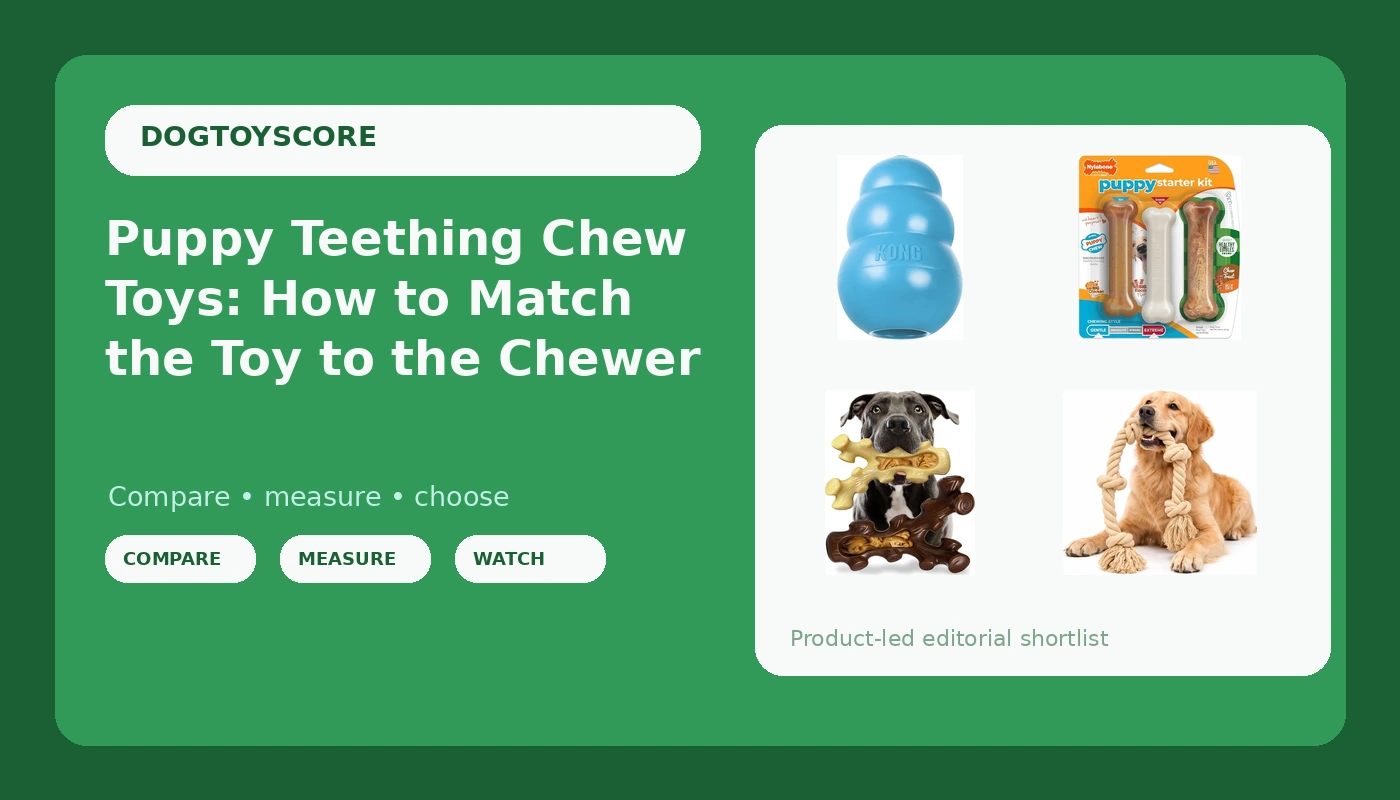
| KONG Puppy, Natural Rubber Teething Chew Toy, for Medium Puppies, Blue | Teething puppies and moderate chewers | Puppy-specific natural rubber chew with a hollow center that accepts treats or kibble |
| Nylabone Puppy Chew Puppy Starter Kit Dog Chew Toys & Treat, 3 Count, Small | New puppy owners who want to test a few textures | Three-piece starter kit with puppy chews and a treat, sized small |
| SIHRMIU 2 Pack Dog Chew Toys for Aggressive Chewers | Medium and large dogs who chew hard | Two tough chew bones in one pack, marketed for aggressive chewers and for teeth cleaning |
| Ali+Oli Pets Dog Rope Toy for Large Dogs, Heavy Duty 5-Knot Cotton Tug-of-War Rope | Interactive tugging with large dogs under supervision | Five-knot cotton rope built for tug-of-war play |
The teething baseline: KONG Puppy, Natural Rubber Teething Chew Toy, for Medium Puppies, Blue
The reason a hollow rubber chew earns its place in a puppy household is that it solves two problems at once. As a chew, the rubber gives a teething puppy something to work on that is not your baseboard. As a food toy, the cavity can be packed with kibble, a smear of something soft, or a frozen mix, which converts a five-minute chew into a longer stretch of mental work. Enrichment matters here: a puppy whose brain is occupied tends to chew furniture less.
The trade-off is that this is a puppy tool, not a lifetime purchase. Puppy rubber is meant to be gentler than the adult version, so a dog who graduates into serious jaw pressure can start to compromise it. That is normal and not a defect. It is the point at which you size up and move to a denser material. Until then, inspect the rubber regularly, and retire it the moment you find a chunk missing or a crack that opens when you squeeze it.
The variety kit: Nylabone Puppy Chew Puppy Starter Kit Dog Chew Toys & Treat, 3 Count, Small
Puppies are individuals about texture. Some want give and bounce, some want a firm surface to grind against, and you cannot predict which from the breed. A kit solves that problem cheaply: put all three pieces down over a few days, watch which one gets picked up first and which one gets ignored, and then buy more of the winner in the right size as your puppy grows.
Two caveats worth knowing before you buy. First, this is a puppy product sized small, so it belongs to the teething stage, not to the destructive adolescent stage that follows. Second, flavored chews tend to lose their appeal over time, especially after washing, so a chew that gets ignored in week three is not necessarily a chew your dog dislikes. Rotating it out of sight for a week and bringing it back often restores interest.
The tough pair: SIHRMIU 2 Pack Dog Chew Toys for Aggressive Chewers, Boredom and Stimulating Best Dog Toys for Medium/Large Breed, Tough Almost Indestructible Dog Bones for Teeth Cleaning and Training
Treat the phrase "almost indestructible" as a marketing claim, not a promise. In practice, the durability language on a listing describes the design intent, and the real test is what your dog does to the toy in the first few sessions. A determined chewer will find the weak point on almost anything, and that is not a reason to avoid the product. It is a reason to set a retirement rule before the toy goes down, and to check it after every session.
There is a second consideration that gets overlooked: hard chews and hard teeth are not automatically a good pairing. Dense chew bones give a strong chewer the resistance they are looking for, but if your dog is a senior, has worn enamel, or already has a history of slab fractures, a very firm chew deserves a conversation with your vet before it becomes a daily habit. For a healthy adolescent or adult dog with a history of destroying softer toys, a firm chew bone used under supervision is a sensible next step up the durability ladder.
The tug option: Ali+Oli Pets Dog Rope Toy for Large Dogs, Heavy Duty 5-Knot Cotton Tug-of-War Rope for Aggressive Chewers, Durable Interactive Chew Toy
Rope is the category people most often misuse. A tug toy is a two-player game, and it does its best work when a person is on one end of it, controlling the intensity and ending the game before the dog gets over-aroused. Left alone on the floor as a chew, rope starts to fray, knots loosen, and strands get swallowed. Rope that has been pulled apart into long threads is the version of this toy that ends up in a stomach.
Used correctly, though, a rope is one of the most useful things in a toy basket. Tug is a fast way to burn physical energy indoors, it gives a large dog a legal outlet for grabbing and pulling, and it doubles as a training reward for dogs who are not food motivated. The rule is simple: rope comes out for play, goes away when play is over, and gets retired as soon as the ends start to unravel.
Prices and availability may change. Product images, names, and retailer links must be matched by verified ASIN. Do not state a current price, rating, stock status, or measured result without current evidence.
Why puppy chews and power chews are different products
The two categories exist because the mouths they serve are not the same. During teething, a puppy's gums are inflamed, baby teeth are loosening and falling out, and adult teeth are erupting through tissue that has not yet toughened. Chewing applies counter-pressure that feels good, and the puppy will seek it out whether or not you provide a legal target. What a teething puppy needs is a material with enough give to be satisfying without being so hard that it punishes a wobbly baby tooth.
A power chewer is a different animal entirely, often literally. This is a dog who has learned that toys are a problem to be solved, and who will work a seam, a corner, or a knot until something gives. For that dog, softer puppy materials disappear quickly, and the answer is a denser material, a larger size, and a toy with fewer weak points. Confusing the two categories is the most common buying mistake: people hand a puppy chew to an adolescent destroyer and wonder why it lasted an afternoon, or hand a dense chew bone to a four-month-old and wonder why the puppy lost interest.
Size follows the same logic and deserves its own warning. Toys are frequently sold by breed, which is a rough proxy at best. What matters is the size of your dog's mouth and the width of the toy relative to it. A toy small enough to be swallowed whole is a hazard no matter how tough the material is, and a toy so large that your dog cannot comfortably hold it will simply be ignored.
How to judge a chew toy before your dog does
Start with the construction, not the label. A single molded piece with no glued-on parts, no squeaker, and no detachable appendages has fewer places to fail. Squeakers are a particular concern: a toy marketed as tough that contains a squeaker is two products in one, and the squeaker is the part that ends up somewhere it should not be. Rope toys have the opposite profile, since their strands are designed to be chewed and will eventually loosen, which is why they are play toys rather than unattended chews.
Then think about hardness against your dog's teeth. Very firm chews suit strong jaws, but hardness that does not yield can be tough on enamel, especially in older dogs. A chew should have a little resistance to a thumbnail but should not feel like a rock. Finally, look at the shape. Chews with rounded ends and a bit of texture do more for a dog's teeth than smooth, flat surfaces, and shapes that a dog can hold down with a paw get used longer.
- Measure your dog's mouth, not its breed label, and choose a toy too large to swallow.
- Identify the chew style: gentle, moderate, or the kind that compromises a standard toy in one session.
- Match the material to that style, with rubber for teething and stuffing, dense chews for hard chewers, and rope for interactive play.
- Inspect the construction for seams, glued parts, squeakers, and detachable pieces before the toy goes down.
- Supervise the first sessions and write your own retirement rule for cracks, missing chunks, and frayed rope.
Practical guidance for a toy basket that works
- Rotate three toys rather than leaving ten on the floor. Novelty drives chewing more than quantity does, and a toy that comes back after a week feels new again.
- Freeze a stuffed rubber chew for teething relief, and use plain kibble or a soft mix rather than anything rich enough to upset a puppy's stomach.
- Retire any chew with cracks, missing pieces, or rope ends that have come apart. A compromised toy is a swallowing risk, not a bargain.
- Size up as the jaw grows. A medium puppy chew is a stage, not a permanent choice, and the transition usually happens around the time baby teeth are gone.
- Keep rope and tug toys for supervised play only, and end the game before your dog is over-aroused.
- Skip toys sized by breed and choose by jaw instead, especially for dogs at either end of the size range.
Which option should you choose?
Choose the KONG Puppy, Natural Rubber Teething Chew Toy, for Medium Puppies, Blue when you have a teething puppy who needs something to work on, and you want a chew that can double as a stuffed or frozen food toy. Choose the Nylabone Puppy Chew Puppy Starter Kit Dog Chew Toys & Treat, 3 Count, Small when you are still learning which textures your puppy prefers and want a small, low-commitment way to test a few at once. Choose the SIHRMIU 2 Pack Dog Chew Toys for Aggressive Chewers when your dog has already chewed through softer options and you need a firmer, larger chew to rotate into supervised sessions. Choose the Ali+Oli Pets Dog Rope Toy for Large Dogs when the missing piece is interactive play, and you want a tug toy for a large dog that you will put away between games.
Two limits are worth stating plainly. Durability language on a product listing describes design intent, not a measured result, and the only durability test that matters is the one your own dog runs. Likewise, no toy is a substitute for supervision, and no chew is appropriate for every dog in a household. If your dog has dental disease, worn teeth, or a history of swallowing foreign objects, get veterinary input before you add a firm chew to the rotation.
The bottom line
Puppy teething chew toys and hard-chewer chews are two different jobs, and the fastest way to waste money is to buy for the wrong one. Start with the material and the size, match them to the mouth in front of you, and let your dog's behavior tell you when it is time to move up a level. A hollow rubber puppy chew handles teething and stuffing, a small starter kit helps you find your puppy's preference, a two-pack of tough chew bones covers the dog who destroys softer toys, and a five-knot rope covers the interactive play that no solo chew can replace. Rotate them, inspect them, and retire them without guilt when they fail. That routine, more than any single purchase, is what keeps a determined chewer busy and your baseboards intact.