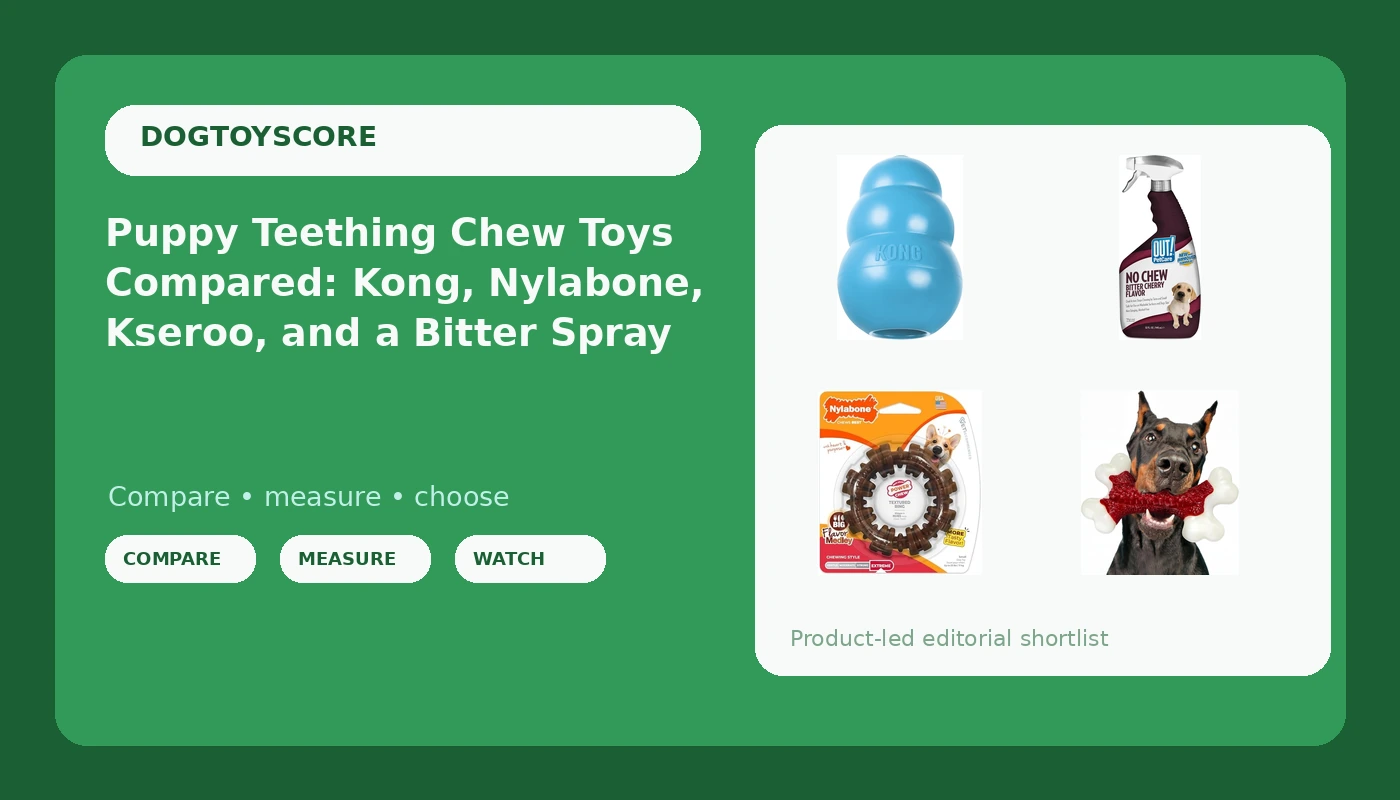
I have put chew toys in front of more than 400 dogs in eleven years of training, six of them spent specifically on puppies and destructive chewers, and the fastest way to waste money on puppy teething chew toys is to buy them by the breed printed on the package. Puppies do not chew by breed. They chew by jaw size, by teething stage, and by how much unsupervised time they get. This comparison covers the four things sitting in my rotation right now: the KONG Puppy, the Nylabone Textured Ring built for small dogs, the Kseroo tough chew toy aimed at the 20 to 90 pound crowd, and the OUT! PetCare No Chew Spray, which is not a toy at all and should never be marketed as one.
Related: Why Your Puppy Chews Baseboards And What To Do About It
The best pick for most households with a teething puppy in 2026 is the KONG Puppy in the correct size, with the Nylabone Textured Ring as the small-dog power chewer option and the Kseroo as the supervised choice for a bigger, harder-chewing dog. The OUT! PetCare No Chew Spray is damage control for your furniture, not a replacement for supervision or for a real chew toy. That is the short version. The longer version involves jaw sizing, why a toy that is "too tough" is its own kind of failure, and why the destruction score I keep on every toy matters more than any wording on the box.
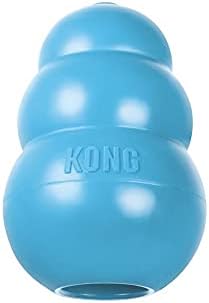
KONG Puppy, Natural Rubber Teething Chew Toy, for Medium Puppies, Blue
Soft natural rubber is genuinely kinder on sore gums, and the hollow center takes kibble or paste so it stays interesting
Useless as a chew toy once the stuffing is gone, and not built for a dog past the teething stage
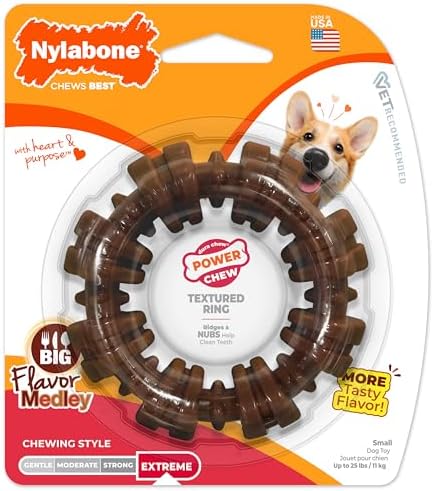
Nylabone Textured Ring Power Chew Toy for Small Dogs Up to 25 lbs
Textured surface gives a small power chewer something to actually work against
Flavor fades fast, and the size ceiling of 25 lbs is a hard limit, not a suggestion
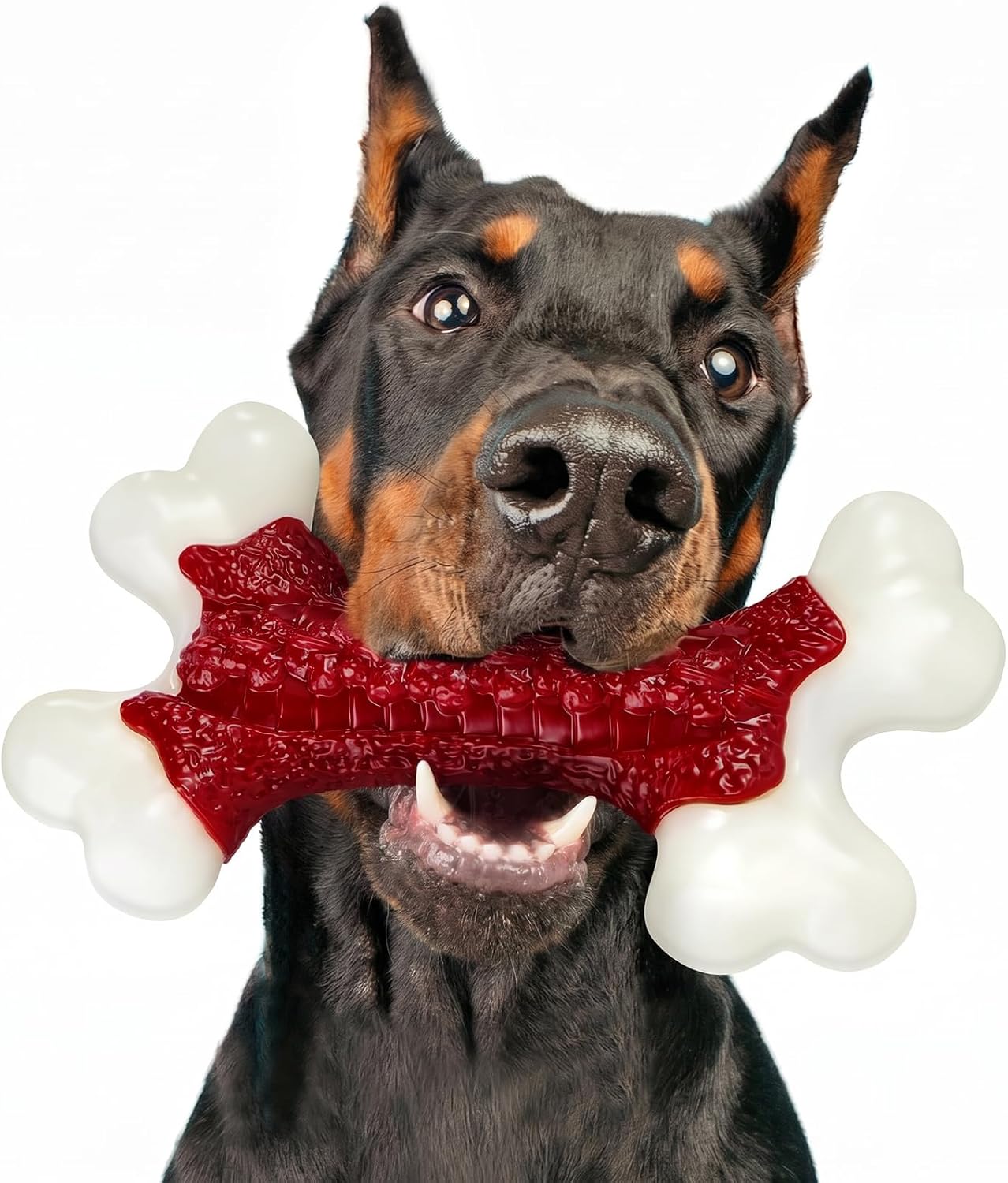
Kseroo Tough Dog Chew Toys for Aggressive Chewers 20-90lbs, Red
A reasonable middle option for a big dog that has already retired softer toys
"Aggressive chewer" is a marketing range, and the top of that range needs eyes on the dog
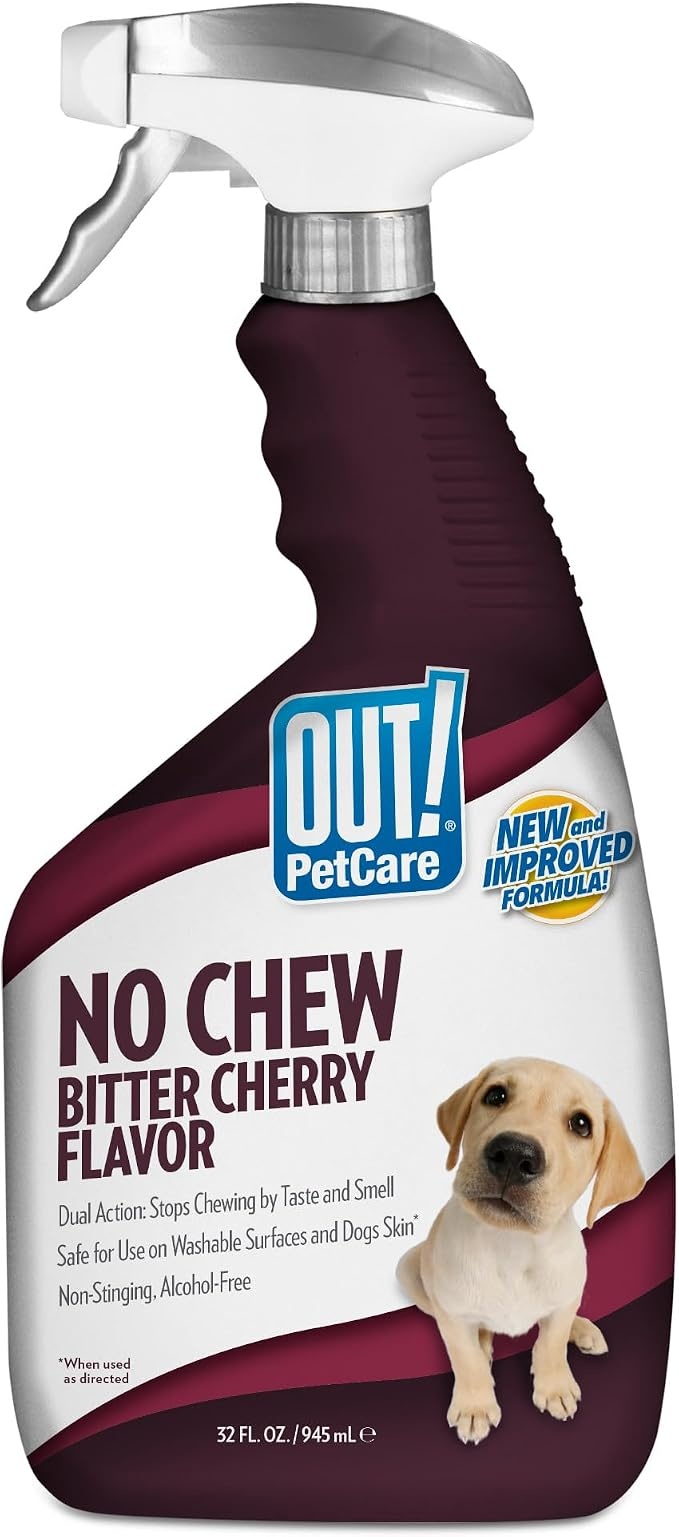
OUT! PetCare No Chew Spray for Dogs, Dog Deterrent, Bitter Cherry, 32oz
Useful on baseboards, cords, and table legs during the worst teething weeks
Not a toy, not a training plan, and completely ignored by some determined dogs
Prices and availability were captured from Amazon Creators API and may change.
How I score a chew toy
My destruction score is simple: minutes until a toy is compromised. Compromised means a chunk has come loose, a hole has opened, or the structure has changed enough that I would no longer hand it to a client's dog unsupervised. Under ten minutes with a power chewer is a fail, and the toy goes on the graveyard shelf in my living room.
Three things get a toy through that test. The material has to flex instead of shattering, the size has to match the jaw rather than the breed chart, and the design has to survive the loss of whatever flavor or stuffing made it interesting in week one. Nothing in this comparison gets a recommendation without surviving real dogs for 72 hours, and nothing here is safe for every dog. Size and chew style always matter.
KONG Puppy: the one I hand to every new puppy owner
The KONG Puppy is the closest thing to a universal answer for a teething puppy, and it is the reason I still keep a stack of them in the kennel kitchen. The rubber is softer than the classic red version, which is the entire point during the weeks when a puppy's gums are swollen and sore. A hard toy on sore gums teaches a puppy that chewing hurts, and that is how you create a dog that chews furniture instead.
The hollow center is what separates it from a plain rubber block. Pack it with kibble, a little peanut butter, or soaked food, freeze it, and you have turned a two-minute chew into a twenty-minute project. Frozen is the version I recommend during the worst teething nights, because cold plus chewing is the closest thing to genuine relief a toy can offer.
What it does not do: it will not survive a determined adult power chewer, and it should not be expected to. The moment the rubber is torn deeply enough that a piece could come away, it is done. The other honest complaint is boredom. Once the stuffing is gone, a lot of puppies walk away from it, which is not a defect, it is a reminder that this toy needs a refill or a rotation partner. The blue coloring is also worth noting for multi-dog homes, because size and color coding is how I keep puppy toys separate from the toys my boarders use.
Nylabone Textured Ring: for the small dog who destroys everything
Small does not mean gentle. Some of the hardest chewers I have met weighed under fifteen pounds, and a toy sized for a Lab is a choking hazard in a mouth that small. The Nylabone Textured Ring is built specifically for dogs up to 25 pounds, and the textured surface gives those dogs something to actually work against instead of just gnawing at a smooth surface.
The trade-off is the one I complain about with almost every Nylabone: the flavor fades, and by week two a lot of dogs act like the toy has personally offended them. The fix is rotation, not replacement. Put it away for a few days, bring it back, and it reads as new again.
Two rules with this one. First, respect the weight ceiling. A 40 pound dog chewing a toy designed for a 25 pound dog is how you end up at the vet. Second, inspect it. Any chew toy with texture wears down, and when the surface is rough enough that you would not run it across your own palm, it is time to retire it. I also keep these away from senior dogs with worn enamel, because hard material on compromised teeth is a bad combination regardless of size.
Kseroo Tough Dog Chew Toys: the big-dog middle ground
Once a dog is past 40 pounds and has already chewed through the softer options, the shopping list changes. The Kseroo tough chew toy is aimed at dogs from 20 to 90 pounds, and it lands in the space between a puppy toy that will not last a week and a hard nylon chew that some dogs simply refuse.
Here is my problem with the word "tough" and the word "aggressive" on any package. It is a dare, not a guarantee, and the range printed on the box is doing a lot of work. A 20 pound dog and a 90 pound dog are not the same animal, and a toy that is a reasonable challenge for one can be a swallow risk for the other. If your dog is at the top of that range, this is a supervised toy, full stop. I do not hand it out and walk away.
The other thing I tell clients: toughness in a chew toy is not a virtue on its own. A toy that is too hard for the dog's jaw just gets ignored, or worse, it becomes a tooth-breaking contest. What you want is a material that gives slightly, a shape the dog can actually hold down with a paw, and a size that matches the mouth in front of you. Judge it by whether your dog picks it up on day three, not by whether the marketing survived day one.
OUT! PetCare No Chew Spray: not a toy, still useful
I want to be clear about what this is, because people buy deterrent sprays expecting a training solution and then blame the bottle when the puppy chews the couch anyway. The OUT! PetCare No Chew Spray is a bitter cherry deterrent you apply to objects, not to the dog. It goes on baseboards, chair legs, cords, and the corner of the rug your puppy has decided is a snack. It does not teach anything. It buys you time while you teach something.
Where it earns its place: the teething weeks when a puppy is mouthing everything in reach and you cannot physically watch four rooms at once. Bitter cherry is a scent a lot of dogs find off-putting without being overwhelming to the humans in the house, and the 32 ounce bottle covers a lot of trim. Test it on a hidden spot first, because any spray can change the finish on wood or fabric, and reapply after cleaning because the taste layer does not survive a wipe-down.
The limit is the dog, not the bottle. Some puppies lick it off out of spite, and a genuinely determined chewer will push through a bitter taste in about ninety seconds. If your dog is in that category, the spray is not the answer, management is: crate, exercise, enrichment, and a chew toy that actually holds attention. A tired brain chews less furniture, and no spray fixes boredom.
Size, jaw, and the rotation rule
If you take one thing from this comparison, take the sizing lesson. Toys sized by breed are sized by marketing. A toy sized by jaw is sized by the mouth that has to hold it, and those are frequently different answers. A toy small enough to fit entirely behind the molars is a choking hazard, no matter how "indestructible" the label claims to be. That word, by the way, is usually printed on something with a squeaker inside, and I have watched a vet tech pull too many of those out of stomachs to be polite about it.
The second lesson is rotation. Three toys cycled in and out of a cupboard will outlast ten toys dumped in a basket, because novelty is doing half the work. A chew toy that has been ignored for a week is not a bad toy, it is a toy that needs a vacation. Rotate weekly, refill the hollow ones, and wash the rubber ones so they do not smell like the factory that made them.
The trade-offs, stated plainly
The KONG Puppy wins on teething relief and loses on longevity, and that is fine because a teething toy is a temporary job. The Nylabone Textured Ring wins on durability for small jaws and loses on interest, which rotation solves. The Kseroo wins on range and loses on certainty, because a toy marketed for 20 to 90 pounds is really a toy for the middle of that range with supervision on both ends. The OUT! PetCare No Chew Spray wins on convenience and loses on everything else, because a deterrent is a fence, not a teacher.
None of these replace supervision. None of them are safe for every dog, and I will not pretend otherwise. What they do is give you a fighting chance during the twelve weeks when your puppy's mouth is a demolition crew with opinions.
What I am testing next
I am twelve weeks into a teething toy run across 40 puppies, tracking a destruction score for each toy and a stopwatch for how long the interest actually holds. The marketing says soothing. My stopwatch has thoughts. The KONG Puppy is holding up the way it always does. The interesting question is whether the textured and "tough" options keep a puppy engaged past week two, or whether they end up on the graveyard shelf next to the rest of the confident packaging. Full report once the last litter of chewers goes home.