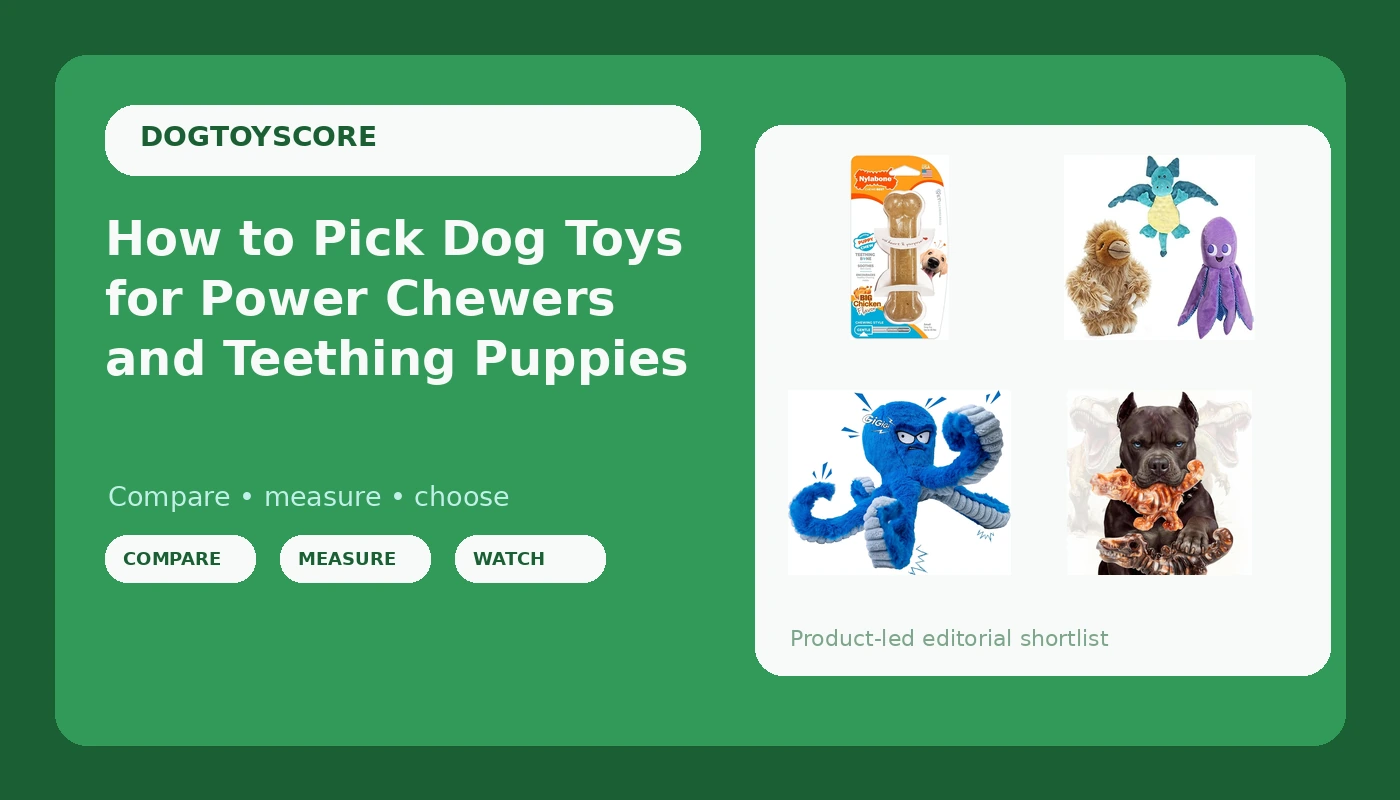
Choosing dog toys for power chewers and teething puppies comes down to two questions that have nothing to do with how a toy looks on a shelf: how quickly can your dog compromise it, and does its size match your dog's jaw? Most shoppers start with the label, and the label is usually the least useful information on the package. "Indestructible" is a marketing claim, not a material specification. "For puppies" can describe anything from a four-pound Chihuahua to a forty-pound Lab mix. What separates a toy that survives from one that ends up in the trash is the combination of material, size, and the chewing style of the dog standing in front of you. This guide walks through four very different toys and explains which dog each one actually fits, so you can buy once instead of replacing the same shredded toy every month.
Related: Puppy Teething Timeline: What to Expect Month by Month →
Quick answer
No single toy is right for every dog, and the packaging rarely tells you what you need to know. Match the material and the size to your dog's chewing style first, then decide how much supervision the toy requires. A small chicken-flavored chew bone suits a puppy inside the teething window. A rock-hard nylon chew is aimed at the dog that destroys softer toys. A squeaky crinkle toy is for interactive tug and fetch with a person on the other end. A plush bundle is for gentle mouths and supervised games. Do not label a product the quietest, fastest, safest, or best unless the available evidence supports that distinction.
4 useful options
| Model | Best fit | What stands out |
|---|---|---|
| Nylabone Puppy Chew Teething Bone Dog Chew Toy, Chicken Flavor, Small | Puppies in the teething window | Small size and chicken flavoring aimed at puppy jaws |
| DinoBone 2-Pack Tough Dog Chew Toys for Aggressive Chewers, Rock-Hard Nylon | Heavy, determined chewers | Two rock-hard nylon chews in a single pack |
| LEGEND SANDY Tough Dog Toys, Stuffed Chew Large Dog Toys to Keep Them Busy, Interactive Squeaky Tug of War Doggie Toy, Crinkle Blue Octopus | Interactive tug, fetch, and supervised play | Squeaker and crinkle texture in a large stuffed octopus |
| BARKBOX Best of BarkBox Interactive Plush Dog Toy Bundle | Gentle players and supervised games | A bundle of interactive plush toys rather than a single item |
For teething puppies: Nylabone Puppy Chew Teething Bone Dog Chew Toy, Chicken Flavor, Small
Puppy teething is a stage with an end date, which changes how you should shop. A chew that a puppy will outgrow in a few months does not need to survive a decade, but it does need to be the right size while it is in use. This bone is offered in a small size and a chicken flavor, two details that matter more than most people expect: flavor is what keeps a puppy coming back to the same object instead of the baseboard, and size determines whether the chew is comfortable to hold between the paws. The trade-off is durability. A small puppy chew is not built for a hundred-pound dog, and handing a puppy-sized chew to an adult power chewer is how pieces get swallowed. Match the size to the jaw in front of you, and expect to replace it as your puppy grows.
For aggressive chewers: DinoBone 2-Pack Tough Dog Chew Toys for Aggressive Chewers, Rock-Hard Nylon
Hard nylon is the material category that most often gets called indestructible, and it deserves a more careful description than that. Nylon resists puncturing, which is exactly what a determined chewer does to softer rubber and fabric. It does not resist abrasion forever, so a nylon chew wears down over weeks or months and eventually develops rough edges that need to be checked and eventually retired. The two-pack format is the practical part here: a dog that fixates on one object gets bored with it, and swapping between two identical chews keeps the interest level higher than leaving a single chew on the floor. The trade-off is that hardness cuts both ways. Rock-hard chews are the wrong choice for senior dogs, for dogs with worn or fractured teeth, and for any dog whose chewing is more mouthing than grinding. If your dog chews to destroy rather than to gnaw, this is the category that survives longest, but it is not a chew you leave down without checking on it.
For interactive play: LEGEND SANDY Tough Dog Toys, Stuffed Chew Large Dog Toys to Keep Them Busy, Interactive Squeaky Tug of War Doggie Toy, Crinkle Blue Octopus
This is the toy in the group that people misread most often. It is described as tough, and it is stuffed, and those two words get combined into an assumption that it is a chew toy. It is not. A stuffed toy with a squeaker inside is a play object, and its value comes from the interaction: the tug, the fetch, the shake, the sound that keeps a dog engaged with a person. That interaction is genuine enrichment, and for many dogs it burns more energy in ten minutes than an hour of solo chewing. The trade-off is supervision. Squeakers are the single most common toy component that ends up somewhere it should not be, and a stuffed toy left alone with a dog that likes to disembowel things becomes a pile of stuffing and a vet visit. Use it with your hands on the other end, put it away when the game ends, and it lasts far longer than the same toy left on the floor.
For gentle players: BARKBOX Best of BarkBox Interactive Plush Dog Toy Bundle
There is no shame in admitting your dog is gentle with toys. Plenty of dogs carry a stuffed animal around for years without opening a seam, and for those dogs a plush bundle is a better use of money than a nylon chew they will ignore. The bundle format has a second benefit that has nothing to do with durability: variety. A basket with several different plush shapes gives a dog more to choose from, and rotating which ones are available keeps them interesting longer than leaving all of them out at once. The trade-off is the same one that applies to every plush toy. If your dog's play style is shredding rather than carrying, a bundle is several future messes rather than a bargain, and the money is better spent on the nylon category above.
Prices and availability may change. Product images, names, and retailer links must be matched by verified ASIN. Do not state a current price, rating, stock status, or measured result without current evidence.
Why the word "indestructible" tells you almost nothing
The destruction score is a simple idea: how many minutes does it take a specific dog to compromise a specific toy? Ten minutes with a determined chewer is a failure, whether the package says indestructible or not. The problem is that no manufacturer can print a number that applies to your dog, because the variable is the dog, not the toy. A toy that lasts six months with a nine-pound Chihuahua can be opened in under an hour by a sixty-pound pit mix with strong jaws and a lot of free time.
That is why material categories are more useful than marketing adjectives. Plush and stuffed toys are soft by design and will open under sustained chewing. Nylon chews resist puncturing and are the category that holds up longest against heavy jaw pressure, with the caveat that they wear down over time. Rubber and specialty compounds sit in between, and their durability varies enormously from product to product. When you read a product listing, translate the adjectives into material categories, then ask whether that material matches what your dog actually does with a toy. A dog that carries, a dog that gnaws, and a dog that systematically dismembers are three different shoppers.
How to choose: size, material, and chew style
Work through these five steps before you buy anything.
- Estimate your dog's jaw, not their breed. Weight and head shape tell you more about the right toy size than a breed label on a package does, and a toy that is too small for the jaw is a swallowing risk.
- Watch what your dog does in the first five minutes with any new toy. Carrying, gnawing, and shredding lead to three different purchases.
- Match the material to that behavior. Plush for carrying, nylon for sustained gnawing, stuffed interactive toys for play that involves you.
- Decide the supervision level before the toy comes out of the package. Anything with a squeaker or stuffing gets put away when you are not playing.
- Inspect every toy weekly and retire it at the first sign of a loose piece, a torn seam, or a nylon surface worn into rough edges.
Practical guidance for keeping toys in rotation
- Rotate three or four toys rather than leaving the whole basket on the floor, since novelty does more for engagement than quantity does.
- Keep a separate bin for interactive toys so the squeaky ones only appear when you are there to play.
- Freeze a chew for a teething puppy to add a texture change, but check the toy afterward for cracks.
- Size every toy to the smallest dog in the house if you have more than one, because the little one will pick up whatever the big one drops.
- Retire rather than repair. A toy that has been opened, re-stuffed, or glued is a toy with a weak point.
Which option should you choose?
Choose the Nylabone Puppy Chew Teething Bone Dog Chew Toy, Chicken Flavor, Small when you have a puppy in the teething window and you want a chew sized for a small mouth with a flavor that holds attention. Choose the DinoBone 2-Pack Tough Dog Chew Toys for Aggressive Chewers, Rock-Hard Nylon when your dog has already destroyed softer toys and you need the material category that resists puncturing. Choose the LEGEND SANDY Tough Dog Toys, Stuffed Chew Large Dog Toys to Keep Them Busy, Interactive Squeaky Tug of War Doggie Toy, Crinkle Blue Octopus when the goal is play between you and your dog, not solo chewing. Choose the BARKBOX Best of BarkBox Interactive Plush Dog Toy Bundle when your dog is gentle with plush toys and you want several shapes to rotate through supervised play.
One caveat applies to all four. Durability claims are relative to the dog, and none of these products should be treated as safe for every dog in every situation. Size, jaw strength, dental health, and supervision level all change the outcome, and a toy that is appropriate for one dog can be a hazard for another.
The bottom line
The right toy is the one that matches your dog's jaw size and chewing style, and the only honest way to judge that is by material and construction rather than by the adjectives on the package. A small flavored chew fits a teething puppy. A rock-hard nylon chew fits the dog that has already proven it can destroy everything softer. A squeaky stuffed toy and a plush bundle are play equipment, not chew equipment, and they last longest when a person is on the other end of the game. Buy for the dog you have, supervise the toys that need it, inspect them weekly, and retire anything that starts to come apart.