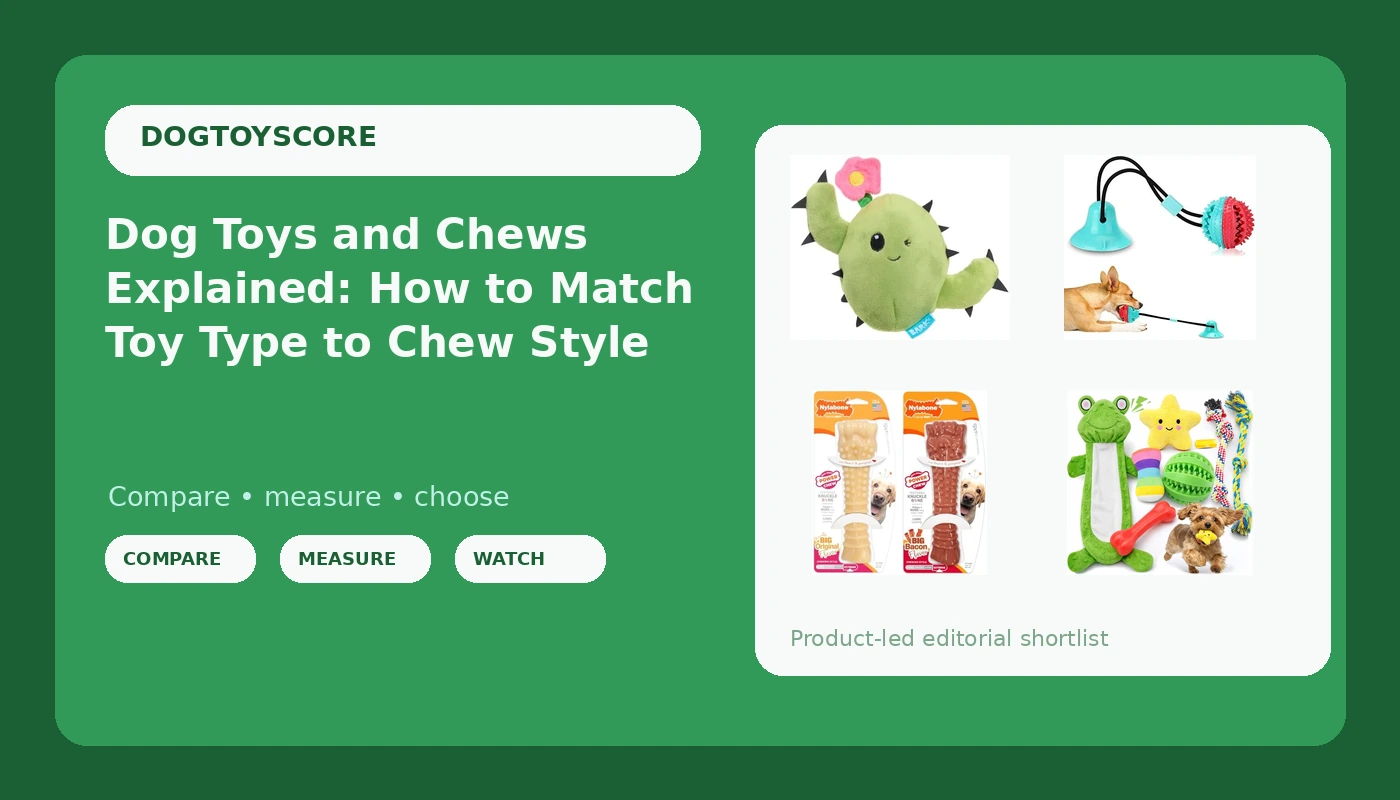
Walk down any pet aisle and the packaging does all the talking: indestructible, soothing, interactive, boredom buster. None of those words tell you whether a toy fits the dog already living in your house. Dog toys and chews get sold by category and sized by breed name, yet the two things that actually decide whether a toy survives the week are jaw size and chew style. A chew built for a Labrador's bite is a choking risk for a nine pound Chihuahua, and a plush toy that a gentle senior carries around like a trophy can be gutted in minutes by a dog who chews for a living.
This guide explains the four toy jobs that cover most households: a puppy starter bundle, an interactive plush toy, a treat dispensing enrichment toy, and a heavy duty chew. It walks through what each one is for, where each one fails, and how to decide which belongs in your basket.
Related: How Toy Rotation Cuts Destruction and Saves Money →
Quick answer
Match the toy to the dog, not to the shelf label. Size chews to your dog's jaw, keep plush and rope toys for dogs who mouth gently, treat treat dispensing toys as brain work rather than unsupervised chewing, and supervise anything with a squeaker, a rope end, or a loose piece. If your dog compromises standard toys quickly, shop the power chewer category and read the size chart before you look at the product photo. No package wording replaces watching your own dog with the toy in its mouth.
4 useful options
| Model | Best fit | What stands out |
|---|---|---|
| LOYEE 8 Pack Puppy Toys for Small Dogs | New puppies and small dogs needing variety | Eight piece bundle with plush, rope, and ball pieces |
| BarkBox Consuela the Cactus 2-in-1 Interactive Plush Dog Toy | Gentle players and supervised interactive play | Two in one plush design in a character shape |
| ALLRIER Dog Toys to Keep Them Busy for Boredom | Boredom and mental stimulation for small to medium dogs | Combines tug play with a treat dispensing ball |
| Nylabone Power Chew Textured Knuckle Bone Dog Chew Toys, X-Large, 2 Count | Heavy chewers who need a durable outlet | Power Chew line, textured knuckle shape, two pack |
Puppy starter bundle: LOYEE 8 Pack Puppy Toys for Small Dogs
The appeal here is rotation on day one. Puppies lose interest fast, and having several small toys you can swap in and out beats buying one expensive item a puppy ignores. The trade off is that a bundle mixes durability levels. Rope and ball pieces usually outlast the plush, and the squeaky plush pieces are the first to go with a determined mouth. That is not a defect, it is the nature of plush. Treat the bundle as a starter kit where you supervise the soft pieces and let the sturdier ones do the daily work.
Interactive plush: BarkBox Consuela the Cactus 2-in-1 Interactive Plush Dog Toy
Plush toys get a bad reputation, and mostly it is deserved when they are handed to a chewer. But plush has a real job: it satisfies the dogs who like to carry, shake, and snuggle something soft. If your dog treats toys like prey and shakes them rather than dissecting them, a character plush earns its place. If your dog's goal is to find the squeaker, skip plush entirely and put the money into a chew instead. There is no shame in admitting your dog is not a plush dog, and pretending otherwise just creates a mess and a vet visit.
Enrichment and tug: ALLRIER Dog Toys to Keep Them Busy for Boredom
Mental work tires a dog faster than running, and a treat dispensing ball turns a handful of kibble into fifteen minutes of problem solving. The caveat is supervision. Enrichment toys with openings, moving parts, or rope handles are not designed to be left with a dog that dismantles things. Use the dispensing side for a structured session, then put it away. Rotating it in two or three times a week keeps it interesting, which matters more than owning a shelf of puzzle toys your dog has already solved.
Heavy duty chew: Nylabone Power Chew Textured Knuckle Bone Dog Chew Toys, X-Large, 2 Count
Durability cuts both ways. A chew that resists a strong jaw is also hard enough that it is not the right pick for every mouth, and X-Large is a size decision, not a default. Match the size to your dog's jaw, check the chew regularly for wear, and replace it once it is worn down or has pieces breaking off. If you have a senior dog or a dog with known dental issues, ask your veterinarian before adding a hard chew to the routine. The chew is a tool, not a babysitter.
Prices and availability may change. Product images, names, and retailer links are matched to verified listings. No current price, rating, stock status, or measured result is stated here without current evidence.
Why jaw size beats breed labels
Breed labels on toy packaging are a rough marketing shortcut, not a measurement. Two dogs of the same breed can have very different mouths: one is a gentle mouther, the other is a power chewer. What you want to know is the size of the toy relative to the dog's jaw and the way the dog uses its teeth.
Too small is the dangerous direction. A toy that fits entirely inside the mouth can be swallowed, and a rope or plush piece that compresses can slide back further than you expect. Too large is usually just inconvenient, though a dog may ignore an oversized chew or struggle to get a grip on it. A quick check: the chew should be big enough that your dog has to work around it rather than close its mouth over it.
Chew style is the second half of the equation. Gentle mouthing dogs do fine with plush, rope, and soft rubber. Destructive chewers need dense material and constant supervision, because the failure mode is not "toy looks ragged" but "piece came off." That distinction decides which of the four options above belongs in your house.
How to evaluate a new toy at home
- Read the size guidance and compare it to your dog's jaw, not to the breed listed on the package.
- Identify what your dog does with toys: carries and shakes, or settles in and chews. That tells you plush versus chew.
- Introduce the toy while you are watching, in the first session, with no other dogs around.
- Watch for the failure signs: pieces separating, squeakers exposed, rope strands pulled loose, chunks coming off the surface.
- Decide within the first few sessions whether the toy stays in rotation, moves to supervised play only, or leaves the house.
Practical guidance for a working toy box
- Keep three to five toys accessible at a time and store the rest, then swap weekly so the selection feels new.
- Separate categories in the basket: plush and rope for interactive play, chews for settling, dispensing toys for structured sessions.
- Check every toy after each session for loose pieces, exposed squeakers, or frayed rope ends, and retire anything compromised.
- Supervise new toys until you know how your dog handles them, and never leave a plush or rope toy with a dog who shreds.
- Match chew size to jaw size every time, and ask your veterinarian about hard chews for puppies, seniors, or dogs with dental history.
Which option should you choose?
Choose the LOYEE 8 Pack Puppy Toys for Small Dogs when you have a puppy or small dog and want a spread of plush, rope, and ball pieces to rotate from day one. Choose the BarkBox Consuela the Cactus 2-in-1 Interactive Plush Dog Toy when your dog carries and shakes toys rather than dissecting them, and you want a character plush for supervised play. Choose the ALLRIER Dog Toys to Keep Them Busy for Boredom when boredom and mental stimulation are the problem, and you want tug play plus a treat dispensing ball for small to medium dogs. Choose the Nylabone Power Chew Textured Knuckle Bone Dog Chew Toys, X-Large, 2 Count when your dog ends soft toys early and needs a durable chew sized to a large jaw.
None of these four is a universal answer, and two of them should not be left alone with a dog that chews hard. The size chart and your dog's own behavior matter more than any category name on a listing.
The bottom line
Dog toys and chews work when the category matches the dog: plush for gentle players, bundles for puppies who need variety, dispensing toys for brain work, and heavy duty chews for the dogs who finish everything else. Buy for jaw size first, supervise anything soft, and retire toys at the first sign of a loose piece. Three toys rotated properly will outlast ten toys dumped in a basket, and the money you save goes toward the chew that actually holds up.